

They discover prestigious contemporary art exhibitions
From July 21 to 24, guided by Cynthia Cervantes, head of international programs at IESA arts&culture, and by their professor Daniel Lesbaches, the MBA Contemporary Art and MBA Arts & cultural management students were able to discover two of the most prestigious contemporary art exhibitions taking place in Germany: “documenta” in Kassel and “Skulptur Projekte” in Münster.

Created in 1955 to promote, in the Germany of the time, modern art persecuted by the Nazis, "documenta" (now in its 14th edition) earned its reputation by offering, every five years, a vast panorama of international contemporary creation. After exploring the Athens part of "documenta" in May (which for the first time is thus held at two sites), the students were able to visit the main exhibitions in Kassel scattered throughout the city.
In perfect counterpoint, the Museum Fridericianum displayed in its rooms the fine collection of the Athens Museum of Contemporary Art (EMST). While in the Greek capital the exhibitions were directly tied to current events and the many crises of today’s world, those in Kassel were more interested in the resonances of history, while exploring the notion of territory that is intimately linked to it.
Among the main sites the students were able to visit is the masterful exhibition at the Neue Galerie. Vast and spectacular, the Neue Galerie, a former postal sorting center, was built in the 1960s in a Brutalist style whose atmosphere and immense spaces are similar to those of the Palais de Tokyo in Paris.
From Kassel, the students then went to Münster. In 1977, the famous curator and museum director Kasper König created in this city the first edition of "Skulptur Projekte" ("Sculpture Projects" in German), which has been held every ten years since. Besides its very slow periodicity, this exhibition has several features that make it unique. First, all the works exhibited are in situ "projects." The invited artists choose a location in the city, generally outdoors, to create a new work. The exhibition directly confronts the problems of public art, from its relationship with architecture to its always controversial public reception.
Visiting "Skulptur Projekte" means exploring a kind of open-air museum of contemporary sculpture. It also means discovering layers of time, the oldest of which are now forty years old, while walking through a city totally destroyed in 1945 whose center was rebuilt identically after the war by the will of its inhabitants. Here again, the collisions of history take on a dramatic and problematic relief.
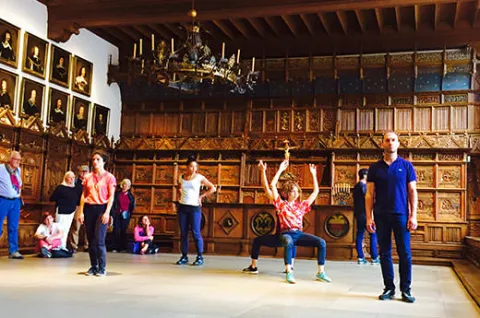
The students were able to discover several remarkable installations, some of which testify to the expansion of the notion of sculpture in the most recent art. If one had to pick one work as the emblem of this fifth edition of "Skulptur Projekte," it would undoubtedly be the magnificent performance (or living sculpture) Leaking Territories by the young Romanian artist Alexandra Pirici. Emblematic, first, through its relationship with history and the contemporary world, it takes place in the reconstruction of the former Rathaus (Town Hall) of Münster and more precisely in the "Hall of Peace." Through work on bodies and language, Pirici deploys, against wars, the essence of diplomacy: "Let the other part be heard too."
In four intense days, the students were able to discover two major series of very high-quality exhibitions (all the displays were particularly beautiful and stimulating) and two events whose rarity makes the visit all the more enjoyable.