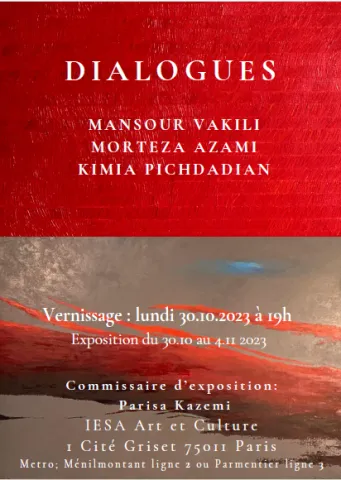
Exhibition: "DIALOGUE"
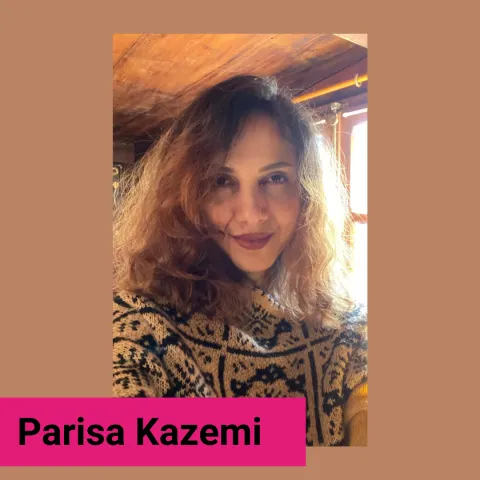
Exhibition curator: Parisa Kazemi
"DIALOGUES"
.
To have a dialogue is to exchange, to remove barriers…
"DIALOGUES" seeks to push the boundaries between the abstract and the concrete, breaking codes and conventional expectations by combining the nobility of canvas and oil painting with ignoble, polluting materials, sometimes recycled. The artist’s talent lies in the ability to astonish us. The aim here is to confront us with our habits so that we become aware of our responsibility toward our environment and the one we will leave to future generations.
Kimia Pichdadian, born after the Islamic revolution in a many-sided country where contradiction is deeply rooted, communicates with a frank and direct accent, speaking hic et nunc. Morteza Azami and Mansour Vakili, who grew up in the "before" Iran, take us into the world of oil painting, the scent of turpentine and colors, in light-filled studios where Ella Fitzgerald’s voice and Louis Armstrong’s trumpet resound. Their works immerse us in the intimacy of a universe that beautifies the soul…
The abstract is inevitably familiar to us. Not only in art, but also and above all in our own everyday experience: the boundary between our deepest intimacy, the place inaccessible to others, and the embodiment of the concrete, the most material elements, is blurred and fluctuating. We perceive it little or not at all. The dialectical process of breaking down the concrete and materializing the abstract generates a new artistic perspective, where the boundaries between these two aspects of art blend harmoniously, thus creating captivating and evocative works.
Mansour Vakili
In the intimacy of each canvas, the artist explores the mysteries of creation. A symphony of colors, a mystical ecstasy that repeats tirelessly. Each work takes the form of an endless journey, becoming both a world in itself and a part of our inner universe. The lines, drawn with an architect’s precision, reveal a vacant space that precedes this mystical ecstasy, the secret passage through which the artist is transported for hours, days, even weeks. If this void did not exist…
To discuss Mansour Vakili’s works without mentioning language would be an omission. Although it is not calligraphy, writing is a figurehead in his creations. Educated in Persian, writing from right to left, then trained in France in Latin letters, Mansour reveals the secret of his art. For he proceeds in the same way when painting as when writing, the gesture of the hand thus becoming an essential element of his artistic process. Born in Tehran in 1946, Mansour is a polymorphous artist. He has taken part in numerous exhibitions and architectural projects, both in Iran and in France. Mansour Vakili’s language is one to be discovered and treasured.
MORTEZA AZAMI
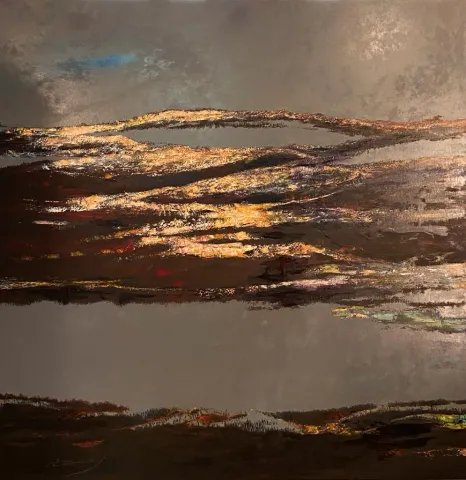
In the studio of the artist Morteza Azami, erasure becomes a resurgence of all darkness. His canvases are worked and reworked, creating an intriguing dynamic where elements of the past seem to dissolve to make way for an emergence, thus inviting the viewer into a deep reflection on transformation and evolution. Driven by the idea of metamorphosis, Morteza Azami feels pushed toward resurgences and the reinvention of his pictorial universe. Each stroke of the knife is an incantation, a promise of optimism, a metamorphosis of the gray canvas into a world vibrant with color and light.
The lines of his works seem to extend beyond the painting, giving the whole an illusion that the lines continue beyond the limits of the canvas, inviting viewers on a timeless journey.
Morteza Azami was born in Tehran in 1948 and then pursued his studies in Switzerland, where he quickly became known as a painter and where his work was discussed in the press. However, during a trip to Paris, the City of Light bewitched his heart, leading him to settle there and pursue studies in architecture. Although his path began in architecture and urban planning, his consuming passion for painting then absorbed him entirely, leading him to fully embrace his artistic calling as a painter.
Kimia Pichdadian
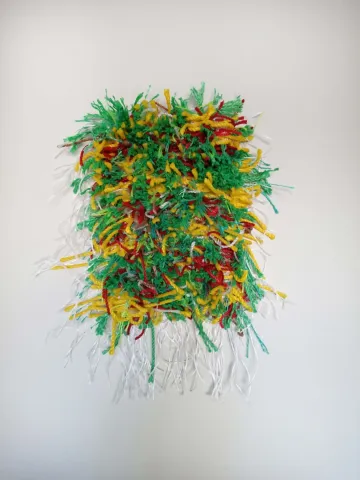
A fervent defender of the environment, Kimia Pichdandian expresses herself through her artworks, tirelessly denouncing overconsumption and the omnipresence of plastic in our daily lives. The rugs woven from plastic rope are works with strong resonance, raising public awareness of the excessive use of this polluting material.
One of her emblematic works is a rug made of packaging, highlighting the prevalence of plastic in our daily diet. This work, with echoes of the Pop Art movement, shocks and challenges, reminding us of the seriousness of plastic being dumped into our oceans. The plastic ropes that sailors use for mass fishing thus become the materials of an artistic protest against this alarming pollution. In a symbolic gesture, she weaves and upholsters in the manner of the women of the Bakhtiar tribes (known for creating the most beautiful rugs, but Kimia uses less noble materials to highlight crucial issues). Born in Isfahan in 1992, a city renowned for its art and architecture, Kimia draws inspiration from her environment in Iran as well as in France. She is a multidisciplinary artist who explores different media, notably painting and installation.
This exhibition is organized by Parisa Kazemi, a student in the professional Master’s for experts in the marketing and distribution of contemporary artworks at IESA, in exhibition curation.