

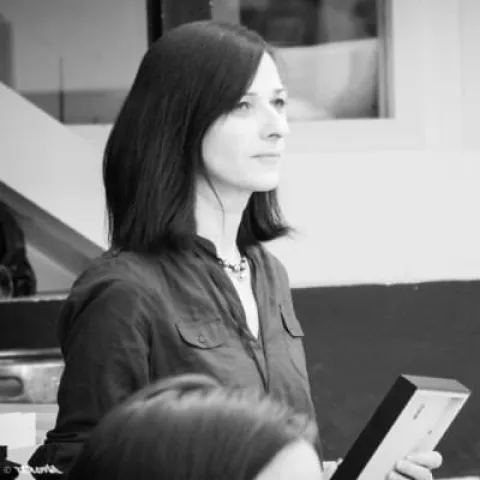
Now in charge of patronage and philanthropy at the Fondation Royaumont, Magali followed the Professional Master in Cultural Project Management and shares her experience with us.
What was your path before IESA?
I was working at the École Spéciale d’Architecture as Communications and Events Manager, at a time when the school was thriving, driven by a leadership strongly oriented toward the international scene, digital arts, and contemporary art, a period of great cultural openness. Hence my desire to specialize more specifically in cultural project management and not only communications, even though I suspected I was heading toward a narrower sector (in terms of the job market).
Which program did you complete at IESA and why did you choose it?
I chose the Professional Master in Cultural Project Administration because of the fairly comprehensive overview it offers of current cultural practices: performing arts production, cultural communication and mediation, heritage management, cultural engineering, but also how public and private cultural policies work, European cultural policies… The very dense format of the professional master’s (8 consecutive months at 35 hours a week, with only one week off) also appealed to me, because it lets you earn the equivalent of an M2 in under 10 months, whereas the M2 takes 2 years.
What did you expect from this program? What do you take away from it?
A precise shift toward culture.
What did the school and your program bring you?
Theoretical knowledge, of course: very solid grounding in economics and public cultural administration with excellent speakers such as Xavier Dupuis and Jacques Charpillon, for example.
Fruitful meetings with professionals who are experts in fields as varied as cultural patronage, contemporary stage production, heritage conservation, mediation, and cultural engineering…
What are the highlights of the program?
The written assignments and oral defenses. The group work that comes before. Studying a subject in project management mode. It is very good training for the return to professional life that follows.
What Is Your Job Today?
I am in charge of patronage and philanthropy at the Fondation Royaumont, an international center for music and dance artists, located 30 km north of Paris.
What did IESA bring to your professional project?
The possibility of getting this position at Royaumont, where the standards are very high. It was at IESA that I discovered cultural patronage, with the tutorial led by Robert Fohr for the theory part and Vincent Timothée for the practical sessions.
At the end of this module, I realized that cultural patronage was a choice that would let me use my communications and events skills, since they are at the heart of patronage practices, while specializing in a specialized, extremely stimulating field that is still growing, as the search for private support gradually becomes the unavoidable solution to offset public disengagement from culture.
A side project?
When I can, I keep helping out with communications at Atelier Manjari & Partners, whose opening of the associative gallery in May 2016 was my graduation project at IESA. But Royaumont no longer leaves me much time, with the succession of projects run by the patronage department (which has just grown to three dedicated full-time people, great progress!)… and the high targets that come with them.
Three people dedicated to patronage is a significant human investment for a cultural institution, but Royaumont has always cultivated a policy of diversifying its resources, which is all the more instructive and stimulating. I am happy to take part in this wonderful human and artistic adventure.