

IESA TRIP TO ROME “Rome, the Eternal City”
Bachelors in Art Expertise and Trade students enjoyed a stay in Rome from October 4 to 7, 2021. This trip, mandatory for 1st-years, was postponed this year because of travel cancellations related to Covid-19. Discover their express and intense journey in this photo report by Jonathan Mbonkodijonat, a student in the Bachelor 2 Cultural Productions.
In L’œil écoute, Paul Claudel evokes the singularity of the gaze, its particular intelligence. Every enthusiast must listen to the works they study.
IESA also regularly organizes study trips to familiarize its students with their future fields of expertise.
As part of their program, first-year students travel to Rome. Under the direction of professors from IESA’s faculty, they engage in dialogue with the Eternal City, in a multidisciplinary approach that should allow them to tackle a large number of subjects useful to their knowledge of the Art Market as well as of Culture Careers.
The choice of Rome is fully justified. A few examples are enough to be convinced.
Studying Rome, its monuments, its paintings, its sculptures, allows us to approach one of the most remarkable centers of European creation and thus to trace the history of art in Europe, century after century, from Antiquity to the present day.
From the Colosseum to St. Peter’s Basilica, from the Piazza del Popolo to the Trastevere district, Rome is inexhaustible!
Some places allow you to get as close as possible to "the making of art". Thus, Vatican City houses the Laocoön, a masterpiece of Roman Antiquity, whose discovery in 1506 considerably influenced contemporary artists, including Michelangelo, who drew on it to paint several figures in the Sistine Chapel.
Rome, through the breadth of its heritage, offers many such connections across the centuries.
Cross-dialogues between the different disciplines also prove fruitful. The city is full of collections built up in past centuries: how did the art market work back then? In this field, how has practice evolved? Under what constraints did a legislative framework emerge?
The study of these collections not only allows us to analyze major works by Raphael, Michelangelo, Caravaggio or Bernini, but also to examine the trade in their works. In addition, many works are kept in their place of origin while others have migrated to museums.
Sometimes, princes built palaces for the sole pleasure of displaying their collection, thus foreshadowing modern museums. These developments are of interest to our time because they question the notions of heritage and exhibition.
Rome is also a city of memory. Many streets and squares preserve the memory of an art of living that now seems bygone.
Religious ceremonies, princely births and weddings were occasions for often grandiose public festivities. Death itself was celebrated!
The performing arts joined forces with the fine arts to enchant the city and amaze the crowd. What was the purpose? Why offer such spectacles to the people? Truth be told, our era has not completely forgotten the use of these mass spectacles…
Finally, the trip to Rome should also facilitate students' integration, build a "team spirit", and unite the group around a shared passion: art and culture, as well as the careers that stem from them.
This study trip therefore has a dual objective: to pass on knowledge and to bring out personalities.
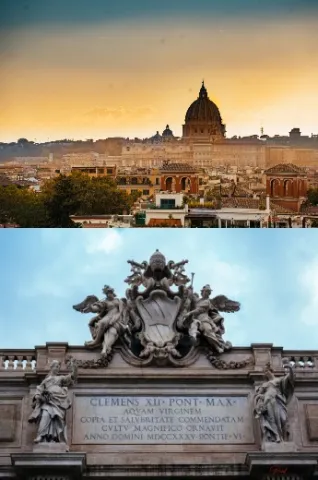
Trip from Monday, October 4 to Thursday, October 7, 2021
Monday, October 4 - ANCIENT ROME
- 05:30 Meet at the Paris Orly airport, Orly 2 Terminal. 7.15 Easyjet flight no. 4241 to Rome. 9.15 Arrival at Rome Fiumicino. Transfer to a hotel in the heart of Rome: Hôtel Hiberia, Via Ventiquattro Maggio, 8, 00187 Rome.
- 11:00 Discovering ancient Rome: the Colosseum, the Roman Forum, Trajan’s Column…
- 13:00 Lunch: free time on the plane.
- 15:30 Visit to the Museo Nazionale Romano, Palazzo Massimo: it houses famous sculptures and paintings, including the frescoes from the House of Livia. The Basilica of Santa Maria Maggiore, one of the richest in Rome, allows a study of the first Christian churches. Then, a must-see stop at San Pietro in Vincoli to discover Michelangelo’s Moses.
Tuesday, October 5 - ROME IN THE RENAISSANCE
- 09:30 Treasures of the Vatican. The best Italian artists, mainly from the 15th to the 17th century, shaped Vatican City. St. Peter’s Basilica and the Papal Palace, including the Sistine Chapel, house works by Fra Angelico, Botticelli, Raphael, Michelangelo, Bernini… To which must be added the papal collections: the Laocoön, the Apollo Belvedere…
- 13:00 Lunch: 1 hour of free time.
- 16:00 In the mid-afternoon, a walk through central Rome will complete this study of the Renaissance: the Piazza del Campidoglio, designed by Michelangelo, the Fountain of the Turtles, a masterpiece of Mannerism, the Palazzo Farnese…
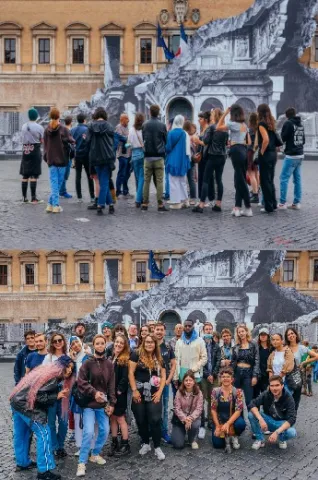
Wednesday, October 6 - BAROQUE ROME
- 11:15 The Triumph of the Baroque. In the 17th century, the capital of Christendom was covered with monuments to the glory of the Church. A flood of gold, marble, and light: the Church of the Gesù, Piazza Navona, the Church of Saint Louis of the French and its paintings by Caravaggio, the Trevi Fountain, the Pantheon, the Church of Saint Ignatius of Loyola and its illusionistic ceiling by Pozzo, Piazza di Spagna…
- 12:30 Lunch: free time for 1 hour.
- 15:00 The Villa Borghese bears witness to the splendor of the decorative arts at that time. It also houses remarkable collections that include several masterpieces, among them: The Deposition by Raphael, David and Goliath by Caravaggio, Apollo and Daphne by Bernini, Venus Victrix by Canova…
Thursday, October 7 - UNUSUAL ROME
- 09:30 Walk through Trastevere: with its narrow streets, small squares, and churches, including the Basilica of Santa Maria, Trastevere forms one of the most picturesque neighborhoods in Rome.
- 13:00 Lunch: free time for 1 hour
- 14:00 Free afternoon to explore a part of the Eternal City on your own.
- 17:00 Rome Fiumicino Airport.
- 22:05 Arrival in Paris