

On Tuesday, April 1, 2025, IESA arts&culture hosted a roundtable on the theme of innovation and new business models in cultural institutions. Moderated by Marie-Sandrine Cadudal, director of IESA, and Yann Le Touher, lead professor of the new Master in Marketing and Development of Cultural Institutions, this meeting explored the different ways of financing cultural businesses and institutions.
Diversified Funding Strategies
Faced with the current challenges of the cultural sector — attracting new audiences, diversifying funding sources, and adapting to technological change — three experts in the field shared their experience:
- Juliette Sirinelli, deputy director of patronage, philanthropy, and brand at the Musée du Louvre
- Gaële de Medeiros, director of economic and international development at the Centre Pompidou
- Léa Morgant, head of the patronage mission at the Ministry of Culture
Juliette Sirinelli notably spoke of the success of the Grand Dîner du Louvre, a flagship cultural patronage event. "We invited stars! We needed a neutral partner, and we chose VISA. We needed the Louvre to be desirable and to make guests want to come back. The gala is a tool for raising funds!" she explained.
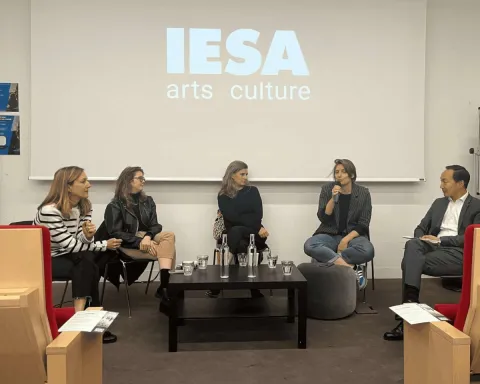
From left to right: Marie-Sandrine Cadudal, Léa Morgant, Gaële de Medeiros, Juliette Sirinelli, Yann Le Touher
The Central Role of Patronage and CSR
Beyond traditional patronage, the roundtable highlighted the importance of corporate social responsibility (CSR) in financing cultural institutions. Gaële de Medeiros, director of economic and international development at the Centre Pompidou, and Léa Morgant, head of the patronage mission at the Ministry of Culture, shared their vision of the evolution of partnerships between companies and cultural institutions. Gaële de Medeiros notably pointed out that cultural institutions, despite the need for private funding, remain "driven by public-service values and missions." Léa Morgant, for her part, shared a clear finding: more than 80% of large companies already engage in patronage, which on average accounts for only 3% of cultural organizations' budgets.
In a context where culture must constantly renew itself and adapt to new economic and social challenges, this roundtable offered concrete and inspiring insight into existing solutions, but also into those that could be developed. Like philanthropy, with the shared observation that the French model is, for now, not well suited to it.
The event was also an opportunity to present IESA’s new Master in Marketing and Development of Cultural Institutions, a program dedicated to professionalizing the cultural sector in the face of these new challenges of developing funding and cultural brands.