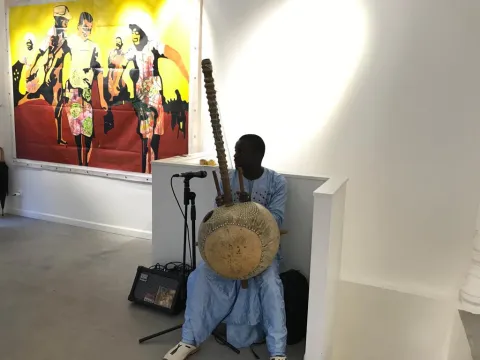
IESA X Exhibition: Contemporary Identities of Côte d’Ivoire
Eight artists from diverse backgrounds exhibited their works in early June in the setting of 24 Beaubourg in Paris, around the theme of "contemporary Ivorian identities."
The exhibition is curated by the director of the Africa department, Hafida Jemni Di Folco.
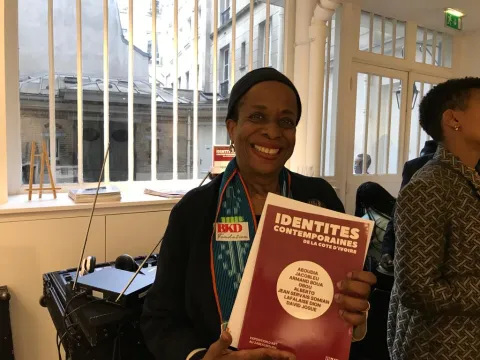
It was a first and a source of pride both for the organizers, the BJKD Foundation, and for the visitors who came to see the exhibition Contemporary Identities of Côte d’Ivoire, held at 24 Beaubourg in Paris in early June, in partnership with the Embassy of Côte d’Ivoire and UNESCO.
We admired the works of eight contemporary Ivorian artists and the quintessence of Ivorian art, namely Aboudia, Jacobleu, Armand Boua, Obou, Alberto, Jean-Servais Somian, Lafalaise Dion and David Josué, carefully selected by the private BJKD foundation (Bénédicte Janine Kacou Diagou, managing director of the NSIA bancassurance group), with, as an underlying question, the exploration of identities in a country rich in history, customs and traditions and in constant change.
In the overall movement of today’s art market, it is sometimes difficult to take the time to examine in depth the contributions of artists in a given context. More and more African artists in general, and Ivorian artists more specifically, are seeking some international visibility. The catch is that they are individuals, explains Jacobleu, a multidisciplinary artist and the exhibition’s curator. "The idea was to show people the works of artists who work on quite different themes and with varied media but who come together on the theme of cultural identity. We also share this contemporary vision of our art," says Jacobleu, whose works saturated with blue, red or yellow immediately catch the visitor’s eye.
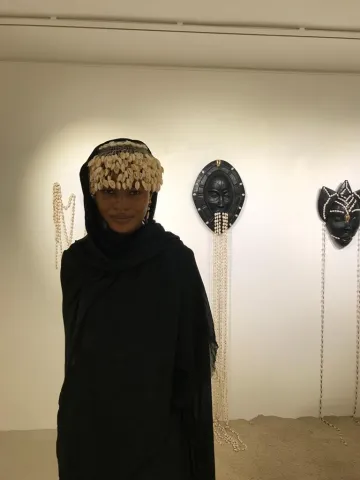
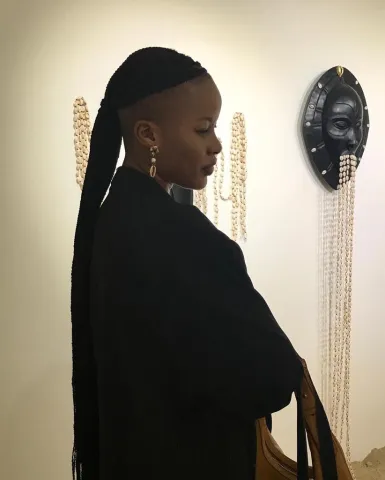
Showcasing Ivorian Culture with Lafalaise Dion
"It is an exhibition that offers several ways of reading it. The return to animism is a theme that comes up many times, for example," notes Hafida Jemni Di Folco, co-curator and scenographer of the exhibition, and Director of the Africa department at IESA. "It is a way of underlining the attachment to the past, to traditions, to values that persist in Ivorian societies, but with elements that also reveal the contemporaneity of the views," the expert adds. "What I liked about this selection are the signals, which are not presented head-on but which visitors can perceive," she confides. "But things are much simpler in the Ivorian context. For example, unlike the arts of Benin where the gods are very present, here it is about animism, respect for the soul; the notion of fear of the gods does not come up. As a result, the outlook is more peaceful," she adds.
The multi-talented designer Lafalaise Dion, with her baby face and kind gaze, accented that day by a pretty line of black eyeliner, revealed her talents as an artist for the first time at the exhibition "Identités contemporaines de la Côte d’Ivoire".
And the tone is set with an installation that resonates with her work as a jewelry designer. Nicknamed the "queen of cowries" for her appropriation of this shell with its rounded face, once a currency of exchange, Lafalaise Dion, who owes her first name to her grandmother, a woman surrounded by mystery, from Man, the mountainous region of Côte d’Ivoire, chose to depict three portrait-masks of women. Which is rare enough to be worth pointing out. "For me, women have a place everywhere. Especially in my work, where I see the cowrie as the symbol of our ancestors but above all of women, creativity and fertility," says the young woman, who keeps a level head even though her creations are worn all over the world.
For the exhibition at 24 Beaubourg, she wanted to feature three strong women: "Go-Guehe," of royal rank, but guardian of history and society; "Adjamou," at the center, plays her role as protector, admired by all. "Always with a view to protecting community bonds (…), she bears the name of her human double, whose physical qualities and moral values she exalts and transfigures. (…) The representation here tends more to materialize an ideal image that acquires an exemplary value," the artist notes in her presentation. "Guéhé Ponh," the third portrait-mask, is depicted in a zoomorphic form. The message is clear: "She comes to fight all threats to spiritual well-being: turning away evil spirits by drawing them to herself."
Obou, Gbai Obou Yves Fredy
As in the work of the painter Obou, Gbai Obou Yves Fredy, his real name, barely 30 years old and already a recognized artist in great demand on the international contemporary art market. Inspired by the culture and history of the Dan people, this graduate of the École nationale des beaux-arts d’Abidjan has chosen to address the human condition, but with an offbeat perspective. Naturally, the young man, who was deeply marked by the traumas of the various political crises, notably that of 2010, decided to make these events a laboratory for exploring the human soul through the very particular use of Dan masks. But not only that. The artist, who now lives in Germany, developed very early on, with other peers of the so-called young generation, his own vision of artistic aesthetics called "braid art." "In his works, the characters are laden with imposing, unsettling symbols, but the decorative elements around them demonstrate the contemporaneity of the gaze," explains Hafida Jemni Di Folco, won over by the artist’s work, several pieces of which adorn the walls of several cities in the country, notably the capital.
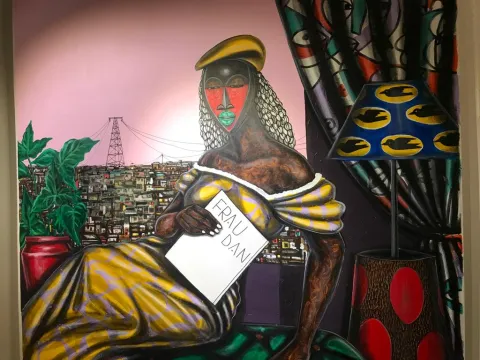
Creative dynamics recognized worldwide
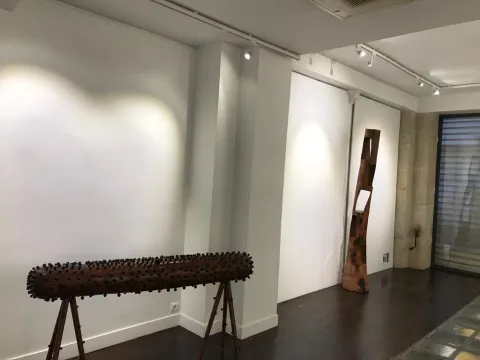
"The initial intention was to find artists with strong ties to their roots. This approach is reflected in our choice to have a common thread, starting with Jacobleu’s works, which are luminous, with scenes of life taking place outdoors, then we invite visitors to go into the house, observe the design, before going deep into the basement of 24 Beaubourg, with works by Alberto, Armand Boua, painter Obou or Lafalaise Dion," explains Hafida Jemni Di Folco, head of the Africa department at IESA.
How can one talk about Côte d’Ivoire’s contemporary identities without mentioning Aboudia? Except in this exhibition, where he presents only a single work, the artist is among the most bankable in contemporary Ivorian art. Abdoulaye Diarrasouba, his real name, is not a man for grand speeches; his meteoric career speaks for him. An explosion of color, play of shapes, layering of objects, drawings, street art, but also sculpture, his pictorial expression has nothing to do with that of the other artists presented, yet this regular of New York and European galleries fully intends to join this new dynamic. This inaugural exhibition marks the opening of an "ambitious project by the BJKD foundation, meant to endure over time and which will give Ivorian artists the chance to meet a wide audience and build ties with private and public French contemporary art players," assures Olga Djadji, its president.
By Viviane Forson, journalist, Le Point