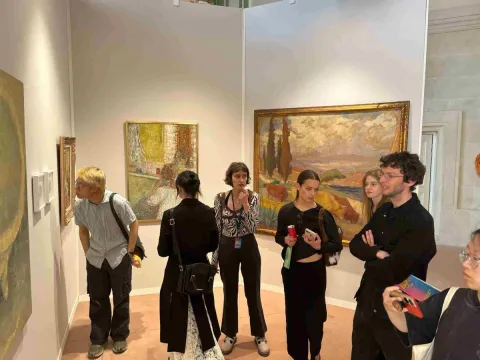
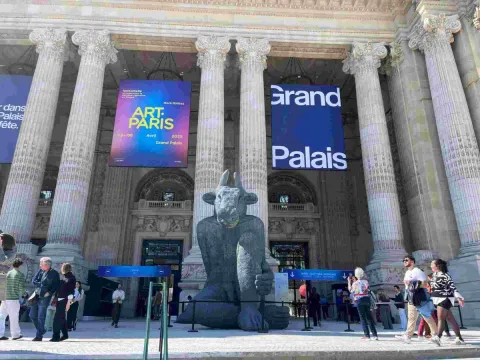
On a bright spring day in April, more than 40 international students from IESA’s Bachelor and MBA programs attended one of Europe’s most important art events: Art Paris 2025. Hosted in the freshly restored Grand Palais, the fair brought together 170 galleries from 25 countries, offering a rich, global panorama of modern and contemporary art. For our students, future professionals of the art world, it was a valuable opportunity to feel the pulse of today’s art market, talk with leading curators and gallery owners, and critically analyze the trends shaping contemporary art discourse.
Organized as part of their curriculum, this educational visit was led by IESA professors Daniel Lesbaches, Fabienne Bideaud, and Guillaume Lefevre, who offered guided tours accompanied by expert commentary. Their analyses helped students better understand the curatorial strategies, market dynamics, and artistic practices they observed.
Art Paris: Program and Vision
Art Paris continues to stand out not only for its scale but also for the quality of its thematic programming, which invites in-depth engagement with the works on display. The 2025 edition featured several key sectors that sparked lively debate among students. "Immortelle"
– A spotlight on figurative painting in France, designed by Amélie Adamo and Numa Hambursin, revisited the dynamic landscape of French figurative painting. Adamo, a writer and independent curator, and Hambursin, general director of MO.CO. (Montpellier Contemporain), had already co-curated "Immortelle" in 2023. For Art Paris 2025, they presented a new analysis, this time taking into account the historical context and intergenerational dialogue through a selection of thirty artists. For students interested in curatorial studies and art history, it was an exciting opportunity to explore the evolution of figurative painting while remaining rooted in tradition.
Another highlight: "Hors Limites," a sector designed by Simon Lamunière, bringing together 18 international artists exploring hybridity, identity, and cultural mixing. This section resonated deeply with students studying postcolonial theory, discourses on gender, and contemporary global perspectives. Its emphasis on multidisciplinary and experimental approaches highlighted the fluid boundaries between media and concepts in today’s art. The "Promesses" sector, dedicated to emerging galleries, gave students a better understanding of the challenges of launching a gallery, building a roster of artists, and entering the art fair circuit. Driven by a bold vision and support for young talent, this sector was particularly relevant for IESA’s future dealers, curators, and gallery owners. A new initiative in 2025: a sector devoted to French Design, highlighting the intersection of contemporary art, functional design, and interior aesthetics. For students interested in cross-over markets, from collectible design to art fair merchandise, this space was a valuable source of inspiration.
Learning Beyond the Classroom
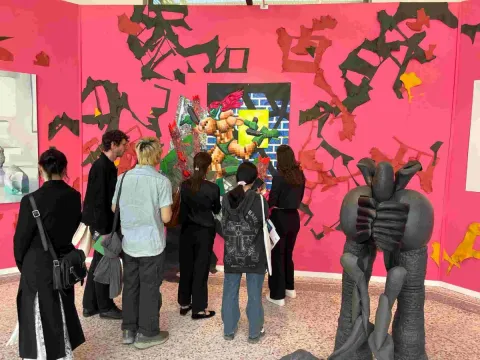
For many students, Art Paris was their first experience of taking part in a major international art fair. Beyond the visual aspect, the visit also offered a glimpse behind the scenes of how a fair is organized. Students were encouraged to evaluate booth layouts, observe the galleries' positioning strategies, note pricing strategies, and analyze how galleries present themselves to different types of buyers. Many took the initiative to talk with gallery staff and artists, practicing professional communication and building their confidence to navigate the commercial art world. Professors led discussions after the visit to help students analyze their observations, assessing curatorial coherence, commercial intent, and the delicate balance between cultural vision and market viability.
A Springboard to Professional Practice
Visits like this one are essential to IESA’s educational approach, where field experience complements academic learning. From curation to community management, including gallery direction and press relations, these moments serve as true living laboratories for professional development. Art Paris 2025 was much more than a fair: it was a transformative experience. It allowed students to see the global art world in motion, to connect theory with practice, and to picture themselves in their future roles in this dynamic and constantly evolving universe. As the Grand Palais buzzed with energy under the gaze of collectors, curators, journalists, and art enthusiasts from around the world, our students left inspired, informed, and ready to take their place in the art world.