

About The Eye Thinks, the Latin American art meetings
L’Œil pense: Monthly Meetings on Latin American Art
About L’œil pense
L’œil pense is the first action of IESA’s brand-new Latin America department in 2015. This department set itself the goal of organizing "off-campus" activities and meetings to allow students to broaden their horizons and networks.
It quickly became clear that the ideal partner for IESA’s Latin America department was the Maison de l’Amérique latine, a central place in Paris where Latin American culture and art are showcased in the finest way, since the end of the Second World War under the impetus of General de Gaulle.
Anne Husson, cultural director of the Maison, welcomed the idea with enthusiasm, and since then, apart from the Covid period, we have been able to hold this event, which has become a must for artists and professionals in the sector. L’œil pense follows the news of exhibitions and visits to Paris by Latin American artists, and also offers in-depth sessions on 20th-century art or the major movements of modern art.
During the first years these sessions were recorded, and our project today is to put these lectures online on a wide variety of rich topics. The head of the department, Grécia Cacères, thanks Anne Husson and the Maison de l’Amérique latine for their unwavering support since the beginning, and Boris Grebille, director of IESA, who created this department with her.
Interview with Anne Husson, cultural director of the Maison
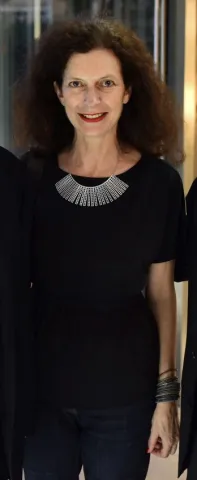
A few questions put to Anne Husson, cultural director of the Maison de l’Amérique latine, co-organizer of L’Œil pense.
How would you define L’Œil pense?
When Grecia Caceres and I decided to name these meetings on Latin American art L’Œil Pense, it was in the jubilant spirit of creating an endless dialogue between image and discourse, the visual and reflection, the sensory and analysis. What could be more obvious and fitting for us than to take up part of a line by the great Mexican poet Octavio Paz, which says The eye thinks, thought sees, the gaze touches. The eye is everywhere, the gaze is constant, and we need to understand and decipher, beyond poetic contemplation, what lies behind a creator’s gesture.
How did the idea of offering these monthly meetings on contemporary art at the Maison de l’Amérique latine come about? And why the partnership with IESA?
It seemed to us that Paris sorely lacked a space for discussion, knowledge sharing and exchange around Latin American art, and that at a time when the Paris scene offered an ever richer choice of exhibitions by Latin American artists - 20th and 21st century -, cultural events, collective and individual initiatives - and a wealth of researchers working on Latin American art (and architecture too), it was urgent and necessary to echo this news, on the one hand, and this discipline in general, on the other, within current events. The art scene, even as it was becoming more and more lively, had remained somehow orphaned of a relay for information and debate, unlike Latin American literature, which has received more attention and exposure from the public and specialists, and has been much more popularized over the last three decades. This has not at all been the case for Latin American art, which has remained more marginal and more absent from people’s awareness, except for the major movements such as Mexican Muralism or, closer to us and still very contemporary, kinetic art.
The partnership with IESA gave these monthly meetings their full meaning. For the Maison, it was valuable to have an art school alongside us, with its structure and teaching tools, its expertise, its student audience, and the Latin America department that Grecia leads. This partnership brought us a brand-new, young audience, surprised to discover that a French (rather than Latin American) institution dedicated to Latin America existed in Paris, and eager to engage with another world. The contribution of this outside perspective, from young people free of any preconceptions about Latin American art, could only be stimulating.
How do you go about putting together the quarterly program?
We scan the news, look at what is happening in museums, galleries, fairs, shows and artist residencies, and there are many of them! We keep watch, so to speak, we are sentinels… We try to be responsive to artists coming to the capital for events. Artists, but also art world players such as collectors, gallery owners, museum curators, art critics, influencers, and academic researchers/doctoral students studying a subject of particular interest. The equations are rich and varied in the art landscape at the moment when we have to draw up the program of guest speakers. At that stage, it is the "L’Œil écoute" touch, as Paul Claudel said, that speaks… (smile).
What were the highlights and the most remarkable guests?
I remember the launch evening of these Meetings, devoted to the Cuban artist Wifredo Lam, whom the Centre Pompidou was celebrating with a major retrospective; a lecture on famous and lesser-known Latin American photographers from the Bibliothèque Nationale collection; a talk on Pablo Reinoso with the curators of BienalSur, which is based in Buenos Aires, in 2019; Géométries Sud with the Fondation Cartier; an evening on women specialists of Frida Kahlo on the occasion of the publication of a huge monograph by Taschen on the artist from Coyoacan; a lecture on the architect who designed the MASP in São Paulo; an artist/curator duo, Lassla Esquivel/Alicia Paz, among others…
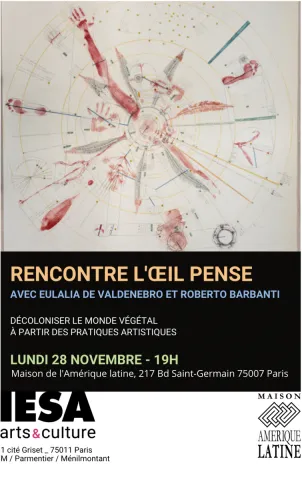
The last L’Oeil Pense session took place on November 29, 2022 at 19:00
Meet the artists Eulalia DE VALDENEBRO and Roberto BARBANTI.
Eulalia DE VALDENEBRO, an artist-botanist, explores in her work a decolonial perspective on the relationship between humans and the plant world through her body. In this conversation, three of her artistic practices will be presented:
- a critical appropriation of scientific botanical illustration and herbarium specimens
- the creation of a living sculpture in the city of Bogotá using species of lianas from the Andean forest
- a video performance made in the Colombian páramos in which the artist reverses extractivist processes from an ecosophical perspective.
The decolonial perspective in her work has two approaches: one refers to the hegemonic relationship that we humans establish with the plant world, and the other refers to the artist’s place of enunciation, a woman racialized as "white," heir to an elite that forged a deeply unequal and violent fabric in contemporary Colombian society.
Eulalia De Valdenebro (Popayán, Colombia, 1978) is an artist-botanist and researcher. Professor at the Universidad Nacional de Colombia, in Bogotá, with a doctorate in Aesthetics, Sciences and Technologies of the Arts from Université Paris 8. She recently defended her thesis at Paris 8 under the supervision of Roberto Barbanti.
Roberto BARBANTI is professor emeritus in the Visual Arts department at Université Paris 8. Co-founder and co-director of the journal Sonorités (2006-2017). Member of the scientific committee of the publishing house Eterotopia France. His research themes include ecosophy, sound ecology and contemporary art.