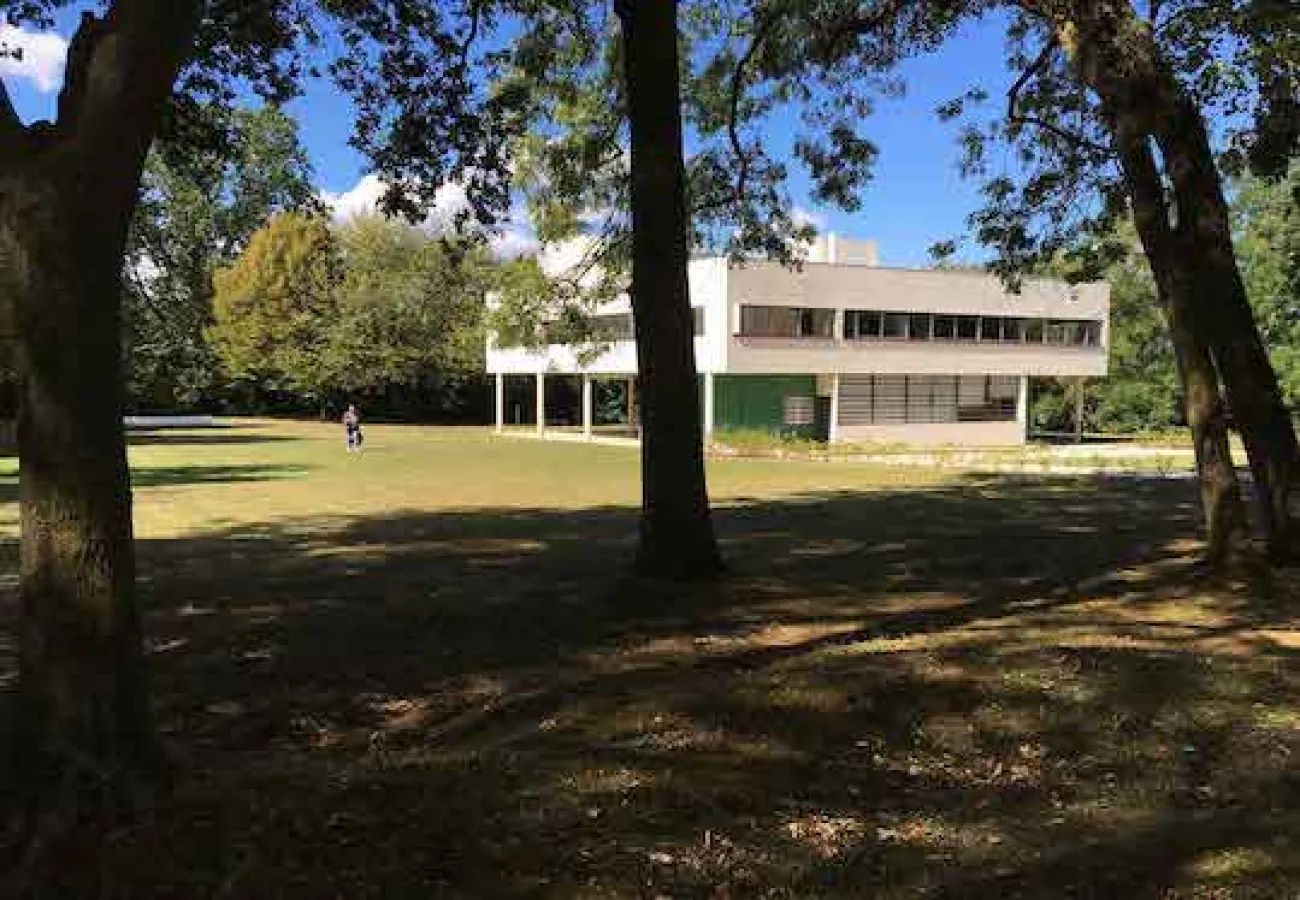
At the end of August, we went to discover the absolute icon of the Modern Movement, the Villa Savoye in Poissy, because IESA arts&culture will be a partner of the Villa Savoye for the upcoming European Heritage Days in 2021.
Built in 1928 for a couple of insurers, the Savoyes, the villa is located 30 km from Paris, where the couple owned a 7-hectare park. Wanting to build a weekend house there, they chose Le Corbusier after discovering the Villa Church in Ville-d’Avray.
When you arrive in Poissy, you have to look for the Villa Savoye: only a discreet plaque indicates its presence. After entering the park, the gardener’s house, a replica of the Villa Savoye, welcomes us, then the back of the villa reveals itself. This major building in architectural history was built by Le Corbusier and his cousin Pierre Jeanneret from 1928 to 1932 according to the five points of modern architecture established by the two architects: free plan, construction on pilotis, ribbon windows, roof terraces, free facade.
The villa now stands on a plot of one hectare. No modernity without the automobile: the size of the park’s driveways and the passages under the pilotis was calculated according to the couple’s cars, so that they could circulate without reversing.
The ground floor is reserved for servants and the garage. The entrance walls are fully glazed, letting light in. In the hall, next to the "catch-all" pedestal table, there is a sink, an incongruity due to the hygienism in vogue at the time.
A spiral staircase for the servants and a gently sloping ramp reserved for the owners, to avoid crossing paths, lead to the upper floor. Le Corbusier conceived architecture as a sculptural work around which the viewer must be able to move to admire its contours, hence the access ramp, while stairs keep the eye from admiring its surroundings because it is focused on the steps to climb.
Upstairs, the living room is bathed in light by the ribbon windows and the gigantic bay window opening onto the terrace. All the rooms on the upper floor are arranged around the terrace, which occupies the largest space on the floor. The only surviving piece of the living room’s original furniture, the immense tubular steel light fixture, inspired by vacuum cleaner tubes, was created at Madame Savoye’s request. The nearby kitchen is reminiscent of a laboratory with its white tiles, the materials used allowing easy cleaning. Storage was planned from the design stage. It is an integral part of each room. On the other side of the terrace are a guest room, the son’s room, and the Savoye couple’s bedroom. Each bedroom has a bathroom. The parents' bedroom incorporates the bathroom within the room itself, with no separation. It has a basin in ceramic tiles and a chaise longue at the edge of the bathtub, evoking the famous LC4 chaise longue created by Le Corbusier, Pierre Jeanneret, and Charlotte Perriand.
The roof garden is an invitation to contemplation with its view over the Seine valley. Accessible by an exterior ramp, the solarium is designed as a space open to the sky, made of curved walls that break with the angular line of the building. A window is cut into a wall and invites you to look at the landscape.
In 1931, the villa was completed; it cost twice the initial budget. Problems quickly arose: the house proved uncomfortable because it was poorly insulated, the terraces leaked, and the paintwork had to be redone. Barely occupied, it deteriorated rapidly. Occupied by the Germans during World War II and then by the Americans, it was severely damaged.
In 1958, the town of Poissy expropriated the Savoyes in order to build a high school on the land, which was cut by 6 hectares. In 1962, the town ceded the villa to the State, which began its restoration in 1963. The building has become the manifesto of modern architecture. In 1965, it was listed as a historic monument, a few months after Le Corbusier’s death. In 2016, it was inscribed on UNESCO’s World Heritage list.
Visiting this monument of modern architecture will delight you. In this green setting, the purity and harmony of the Villa Savoye as well as the gardener’s house, its miniature counterpart, take you on a journey between the two wars. This major building in architectural history has kept its resolutely avant-garde character.