

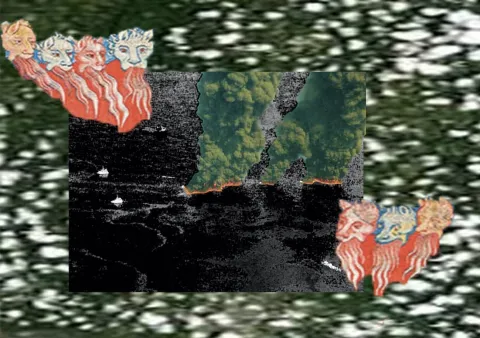
The exhibition We Who Inhabit Your Ruins will take place at the IESA arts&culture gallery from June 22 to 27. This project is organized by Coline-Lou Ramonet, the 2020 winner of the Juvenars-IESA Prize, organized every year for six years by the Bachelor 1 Art Expertise and Trade students.
"The option of learning to live in the ruins is the option of learning to think without the security of our demonstrations" Isabelle Stengers, Reactivating Common Sense: Reading Whitehead in Times of Debacle. This is what Coline annotates at the top of the shared document where I am writing this introductory text. Talking about her artistic work without at least mentioning the name of Isabelle Stengers, a Belgian scientist and philosopher, would indeed be a mistake, since, echoing her thinking, Coline’s pieces escape the authority of the hard sciences, sciences that time has stiffened and crowned queens, sciences that, repeated by billions of voices, have drowned out the song of other possibilities.
Coline’s artistic approach is that of a child who grew up in a family where hard science and magic conversed daily, marrying one another without seeking to establish a hierarchy between them. And it was in contact with the forest standing thick behind her childhood home that Coline felt listened to and observed by her surroundings for the first time. That is why her sculptures and installations smell you, listen to you, look at you, and some even fall silent as you approach. "You can walk past my pieces, but they – like rocks, plants, trees, and insects – they won’t miss you."
In short, Coline’s pieces are islands of poetry floating on the surface of our ocean of rationality. Islands that allow us to step aside and consider ourselves no longer as the center of the world, but as a link in a whole governed by interdependence and reciprocity.
"I create worlds out of next to nothing," she explains. From plaster, paper, wood, and wire mesh. But also from colored pencils and her computer, which she uses to capture images that she then turns into digital drawings. Opposite the entrance, you can in fact see the image that inspired this exhibition. It is taken from Claude-Jean Bonnardot’s TV film Morel’s Invention (1967), which presents the lush garden of an island that the protagonist believes deserted. If you squint, you notice ghostly presences in the background. "The subject is the ruin of a place but also the ruin of human bodies," Coline sends me in a message. From the opaque atmosphere of this suspended garden where one wakes with a start, Coline’s drawings, sculptures, and installations seem to have escaped. In the very middle of a nature that is reclaiming what had been taken from it.
We Who Inhabit Your Ruins is a dive into an ecosystem that does not wait for us. An ecosystem we disturb a little more with each step.
Mév Pacaud