An exhibition that raises awareness at IESA arts&culture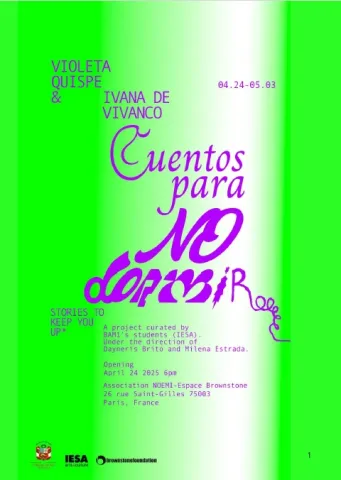
On Thursday, April 24, 2025, IESA arts&culture hosted the opening of Cuentos para no dormir, a committed exhibition curated by Bachelor 1 in Arts Management (BAM 1) students, under the direction of Milena Estrada, a professor at IESA, and Dayneris Brito, project manager and advisor to the Brownstone Foundation’s Cuban art collection.
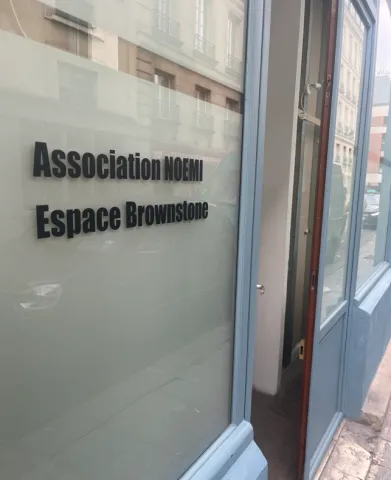
Produced with the support of the Embassy of Peru in France and in partnership with the NOEMI Association – Espace Brownstone, the exhibition allowed two major artists of the Latin American contemporary scene, Violeta Quispe and Ivana de Vivanco, to engage in dialogue for the first time on French soil. A meaningful first that left a mark both through its content and the emotion it stirred.
A countdown, between struggles and transmissions
Contrary to traditional tales that lull and put us to sleep, Cuentos para no dormir – literally "tales not to sleep" – aims to awaken, question, and unsettle. Far from a mere aesthetic experience, the exhibition is a visual manifesto, a call to rethink dominant narratives through the lenses of decolonization, orality, cultural plurality, and gender struggles.
At the heart of this project is the desire to offer an alternative narrative to official history by confronting Andean and Baroque visual legacies with contemporary issues. Art becomes a tool of resistance, memory, and transmission here, in a scenography designed from start to finish by the students of the program.
Two powerful artists, two critical voices
Violeta Quispe (Lima, 1989)
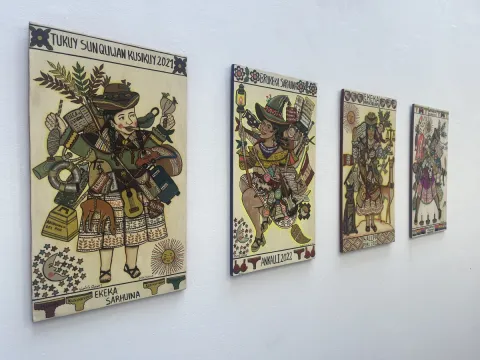
A Peruvian artist and activist of Sarhua origin, she revisits the Sarhua Boards, painted wooden planks rooted in ancestral traditions. In her deeply feminist approach, she subverts the male figure of the Ekeko (a symbol of prosperity) to create female and non-binary Ekekas, questioning gender stereotypes in Andean cultures. Her work, blending natural pigments, earth, acrylics, and oral narratives, evokes collective struggles and intimate forms of resistance alike, particularly those of women who have been made invisible.
Her work has been shown in prestigious institutions in Peru, and most recently at the 2024 Venice Biennale.
Ivana de Vivanco (Lisbon, 1989)
A Chilean-Peruvian artist based in Berlin, she develops a baroque, theatrical, and critical universe. Through her paintings and videos, she questions colonial and patriarchal narratives. In La Yegua de Santiago, she overturns the myth of the conquistador, placing at the center the figure of the emancipated mare, a symbol of resistance and female power. Her work questions the symbols of power and figures of authority, in a visual language that is both satirical and deeply political.
A project endorsed by "Passport for an Artist"
Cuentos para no dormir was also selected as part of the Passport for an Artist competition, the competition that reveals the talents of the Peruvian contemporary scene.
Launched in 1998 by the Alliance Française de Lima and the French Embassy in Peru, the national Passeport pour un artiste competition has become one of the major events of visual creation in Peru. Each year, it showcases young emerging artists, offering them a platform for visibility and international support. A unique springboard for committed and innovative visual artists.
A vibrant and moving opening night
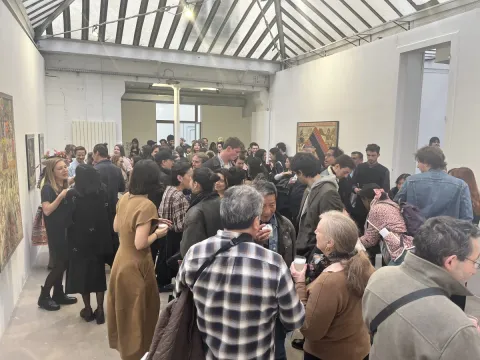
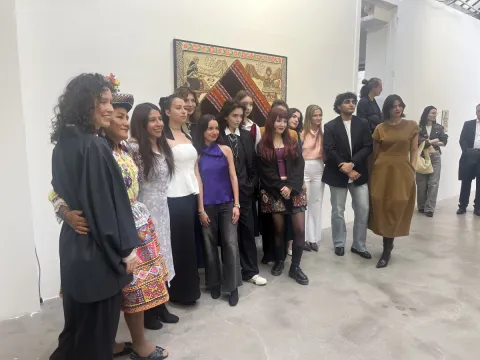
The opening night was a highlight in the life of the school. In the presence of Marie-Sandrine Cadudal, director of IESA, Rolando Javier Ruiz Rosas Cateriano, Ambassador of Peru to France, Gilbert Brownstone, the two guest artists, the supervising teachers, and many students and families, the gallery was full.
Speeches punctuated the evening with emotion and pride. Marie-Sandrine Cadudal, Mr. Cateriano, and Mr. Brownstone stressed the importance of art as a vehicle for dialogue between peoples.
Dayneris Brito, for her part, recalled the deeper meaning of this exhibition: to highlight marginalized voices, denounce systems of domination, whether patriarchal, colonial, or artistic, and defend a plural, inclusive, and decentered vision of contemporary art.
A collective, human, and sensitive success
Beyond the works and speeches, the warm, welcoming, and attentive atmosphere left its mark on all the guests. The students' pride in having brought this project to completion in all its dimensions was palpable: research, mediation, logistics, communication, and scenography.
Cuentos para no dormir will remain a moment of collective awakening, where art brought people together, shook them up, and made them vibrate, in a space of exchange between generations, disciplines, and cultures.