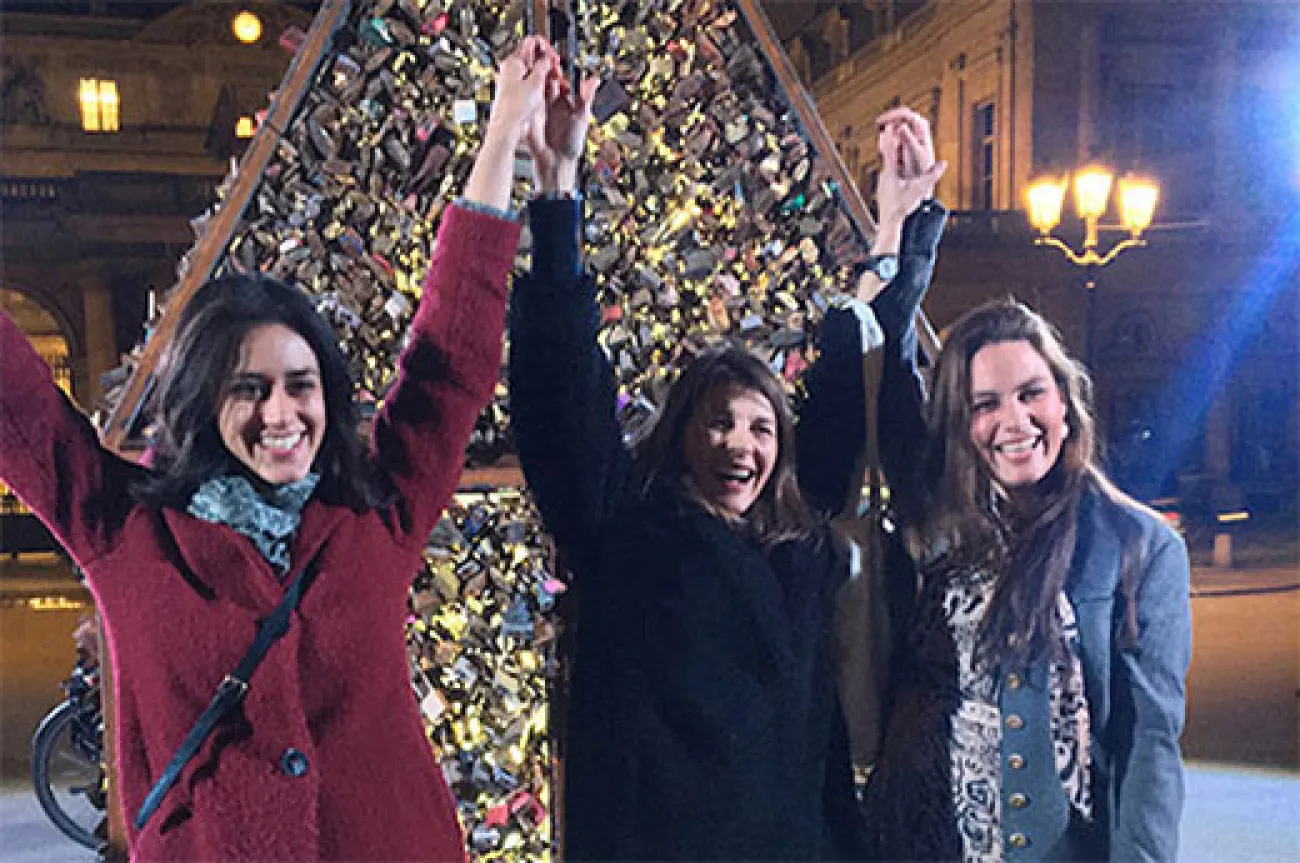
From March 12 to April 28, 2020, the French-Mexican artist Carmen Mariscal is presenting a new installation entitled Our Home on Place du Palais-Royal (Paris 1st).
The exhibition is curated by our alumna Lassla Esquivel, MBA in Contemporary Art, who now teaches at IESA arts&culture and also at Christie’s Education London.
Made from the grilles and padlocks removed from the Pont des Arts and the Pont de l’Archevêché, the artist explores the symbolism of the house as a psychic space and questions the meaning of romantic relationships. The project was born from the artist’s concern about certain Parisian bridges that were threatened by the weight of the padlocks that tourists attached to their railings as proof of love.
Carmen Mariscal reflected on those romantic practices of symbolizing a couple’s union with a padlock, then throwing the key into the Seine. Is love a chain? Must it lock in, mark belonging and possession? What happens when the home no longer represents a space of protection? The hermetic house symbolizes the ambiguity of a relationship that looks perfect from the outside but keeps its secrets well hidden inside…
This work also reminds us that objects carry memory, that each padlock holds a couple’s personal story, their dreams and their desires.
Carmen Mariscal had already worked on the weight of traditions borne by women, notably in La novia puesta en abismo (1997 - 1998) [The Bride Placed in Abyss], La esposa esposada (2018) [The Handcuffed Wife] and Calladita te ves mas bonita (2019) [Be Pretty and Keep Quiet]. These different works explore the more or less tacit social injunctions that women must comply with: a marriage-and-children pattern in which they are supposed to flourish, or otherwise be rendered invisible by society.
The sculpture Our Home is conceived as a “house-prison” 3 m high and weighing nearly 5 tons; it is the symbolic embodiment of marital and domestic traps.
The sculpture is at once solid and fragile, dark and luminous. For Carmen Mariscal, it is an archetypal space that should invite passersby to reflect on love and its permanence through the ups and downs of daily life.
How can a simple carefree gesture - tourists wanting to leave a trace of their visit and of their attachment to the city - carry the weight of a normative, gendered and oppressive legacy?
Lovers wish to seal a pact and often dream of a life together, of starting a home… The idea of the padlock that locks in, separates and locks away is probably foreign to them.
For the philosopher Gaston Bachelard, the house has the power to integrate the thoughts, memories and dreams of humanity; it is a great cradle. But what happens when the “cradle” is no longer a space of openness and peace? What happens when we lose the notion of home as a protected space?
Linked to environmental themes, such as the conservation of urban heritage, but also committed to raising awareness for women’s emancipation and the defense of human rights - notably of victims of domestic violence - this work resonates with everyone through the universal and current themes it addresses.