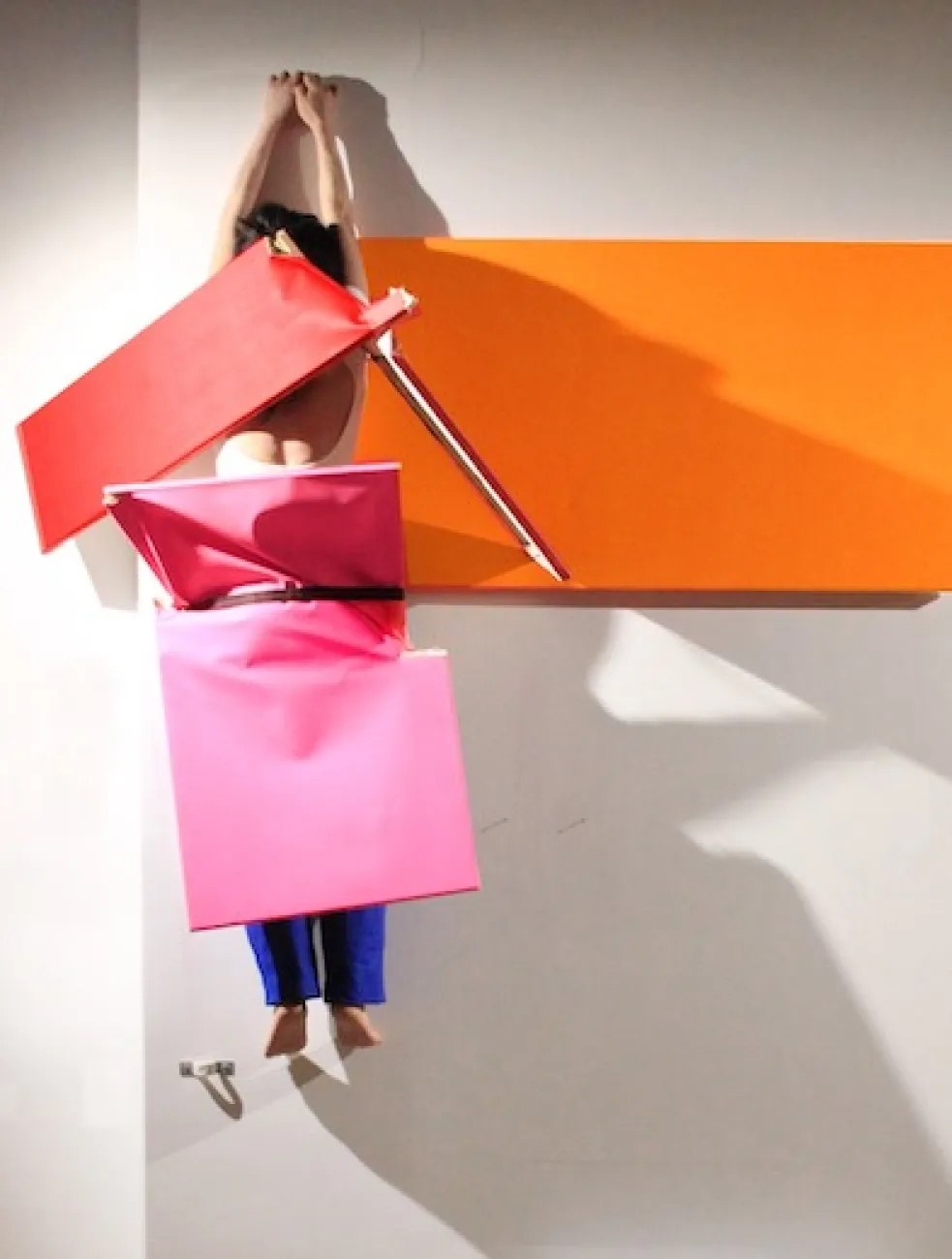
At the end of last March, the Chinese artist Zhao Duan, invited by the Asia Department of IESA arts&culture, gave a performance as part of the exhibition “Paris - Beijing,” presented in the IESA Gallery.
Before the astonished eyes of the audience, this artist literally climbed the wall among several canvases to carry out this performance.
About the artist, text by Yves Michaud, philosopher and art critic
Art as Experience
For an artist, whatever their art, art is first of all a performance: an action, more or less difficult, to arrive at something, requiring more or less technique, know-how or skill, an action that also takes time (sometimes little, often a lot), attention and concentration. This is true of the writer writing a text, the ceramist shaping a vase or a dish, the musician writing a piece or playing it (performance). We tend to favor the end result that we receive in our own time as spectators, a time over which we have more or less control: complete control in front of a painting viewed in passing or attentively, much less control and even none at all at a concert or at the cinema.
When, in the early 1970s, artists began to deconstruct works, some decided to “work” on this dimension of performance, which is by no means negligible since art is always first of all a doing, a poïein as it is said in ancient Greek.
All of Zhao Duan’s productions are, from this point of view, performances: they describe and record a process, whether of painting, drawing or construction. The process may be that of a bus or plane journey, of the co-creation of a work, of an encounter, of a path. Placing the emphasis on performance in this way does not mean forgetting the end result, but it does relativize it, shift the point of view, show the hand that draws or paints rather than the resulting object. When Zhao Duan speaks of her admiration for Francis Alÿs, she expresses her kinship with an artist who puts in the foreground the performance not of the artist but of the work itself: the work is performance.
For an artist, whatever their art, art is also about sharing: a way of entering into communication with someone.
Despite all commercial or social calculations, we do not know who that someone will be. Sometimes the artist knows their audience, the person who commissions a particular piece of music or a particular architecture. Sometimes they know their viewer through the work done by their gallery owner or by the person who decided to exhibit them in an art center. But there will always be other audiences - those who pass by, those who happen to be there, those who will come later, even those who will not come and perhaps will one day regret it - we call that “posterity,” “collectors,” “the public.”
Zhao Duan does not have much confidence in these unknown audiences and chooses to enter into communication, right from the performance, with people who may or may not become co-authors, first recipients, first spectators.
Such are the co-authors of her drawings (her husband included), the models who are not really models, those elderly people whose hand she holds while she paints their face in the hollow of that hand, those other elderly people for whom the artist serves as a backrest and comfort. Even in her relationship to herself in the series of “secret paintings,” there is something of this strange relationship: Zhao Duan paints herself as if she were a stranger to herself, thereby seeking to translate her own situation of strangeness.
When, in the early 1990s, relational aesthetics was brought to the fore as a separate “genre,” that genre came to name this relational dimension of art that has always existed in the eternal relationship with the “spectator.” It then metamorphosed into a relationship “in itself,” a sacramental communion à la Journiac or, more humanly, an alimentary communion. So it was with artists' restaurants such as Miralda, Spoerri or Matta-Clark, or Tiravanija’s soup kitchens for the fashionable.
Placing the emphasis on the relationship in this way does not necessarily mean forgetting the end result, but it does, once again, relativize it, shift the point of view, show the hand that exchanges or gives rather than the resulting object, and also show the process by which art transforms the artist and those to whom it is addressed.
For an artist, whatever their art, art is something secret.
A secret with many drawers: the secret of intentions that are not always so clear and that can become complicated in the process of making, the secret of unconscious projections that are inevitably withheld, the secret of what will not be grasped, understood or perceived, of what we will miss, the secret of what will not be said or shown either because we do not think of it or because, in any case, there is no question of letting it show.
Even when the artist claims to lay their cards on the table, to be transparent (“what there is to see is what is there”), there is a whole thickness of secrecy in both the work and the performance: it is what it is - a drawing on paper, pencil lines along a wall, a performance during an evening - but it is also a whole cascade of secrets or half-admissions. Zhao Duan is perhaps most impressive in this dimension of her approach because it is radical: whoever buys the series of 60 “secret” paintings will only discover after the purchase what appears on these paintings of the painter’s body (perhaps it is nothing, or very little, or banal). Whoever buys the drawings of the Esquirol-Eisenhower series will have to buy the entire series, including the blank drawings of the days without a journey, and perhaps will keep them like an old-fashioned collector in a box, without ever exhibiting them all. There is a desire to preserve - and to stage - the secret that extends even to the destination of the works. The secret is in a way doubled in the circulation of the object.
All of this ultimately leads us to a conception of art as experience: poietic experience (the performance), experience of encounter, experience of secrecy. This experience is fragile, temporal and temporary, charged with intensity and reflection. Zhao Duan started young with drawing, dance, violin and theater. Today she gathers and concentrates in her work as a “visual” artist all the threads of these experiences. By making her work an experience from every point of view, she goes straight to the nature of art - as experience.