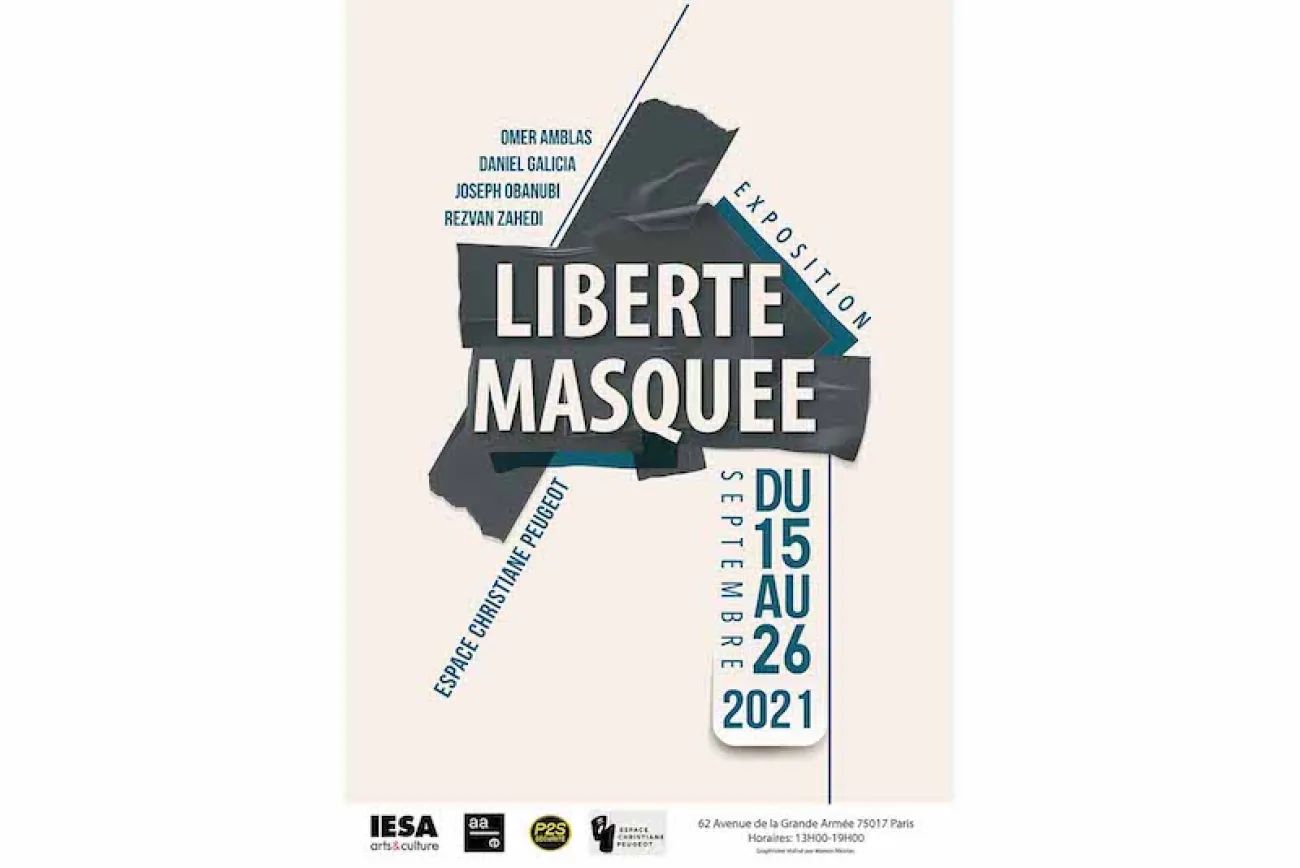
AN EXCEPTIONAL PGR (Real-Scale Project): THE LIBERTÉ MASQUÉE EXHIBITION, proposed by our student in the Professional Master in Contemporary Art, Pascale Richetta.
The exhibition "Liberté masquée" presents the works of four artists of different nationalities, whose creations are as much testimonies to, as confrontations with, their historical, cultural, and personal heritage. The diversity of their approaches shows just how plural "freedom" is. The subject is addressed here in a necessarily arbitrary way, through the eyes of each artist, their experience, and the context in which each of their artistic paths took shape.
Their testimonies demonstrate, if there was any need, the close intertwining of past and present, both through their memories and through their observations of a present sometimes tinged with ancestral colors. Whether it concerns migrations undertaken at the risk of one’s life and rebels (Omer Amblas), access to drinking water in Nigeria (and in other territories) and the dangers faced by the women in charge of collecting it (Joseph Obanubi), freedom of expression, notably that of women, a fundamental right still flouted in many territories (Rezvan Zahedi), or finally the fundamental and very current question of identity and gender (Daniel Galicia), these four artists remind us how fundamental a role art plays in our awareness of the world.
The exhibition "Liberté masquée" will be an opportunity for dialogue with the artists about freedom, but also for a very personal questioning by visitors, no doubt resonating with what they have experienced in recent months. A room will, moreover, be dedicated to the "exemption travel certificates" that have become works of art, thanks to the creations of two of the invited artists, who transformed these certificates into genuine passports to freedom. An exhibition with a definite breath of freedom.
An exhibition about "freedom"?
Freedom is such a rich concept that it is impossible to claim to exhaust all its meanings in a single exhibition. The idea of organizing an exhibition devoted to "freedom" was therefore, de facto, doomed to failure, as it would omit fundamental dimensions. Yet, after these past months of lockdowns, prohibitions, and frustrations, desire outweighed reason, bolstered by the enthusiasm of the artists contacted: the pleasure of sharing would be greater than the risk. Our "masked freedom" could finally find a space where the creations of four artists from four continents would illustrate some of its facets and spark curiosity, passion, and discussion at a time when the world’s tumult is great and when art, the spur of our awareness of the world, is more necessary than ever, perhaps vital.
1•The term "freedom" generally refers to the possibility of action or movement, but also to the possibility for an individual to exercise their will, that is, their full capacity to choose and act without constraint. The word comes from the Latin libertas, which covers several meanings: non-slave, having the rights of a citizen, a people not subject to an authority, independence, and frankness.
2•The abolition of slavery, in 1794 and then in 1848, and the Universal Declaration of Human Rights 3•, in 1948, remain two fundamental texts, the latter specifying clearly that freedom is the right to do anything that does not harm others (article 4), pointing to the potential tensions between individual freedom and collective freedom.
4•Art and Freedom
Art has the capacity to raise awareness; in other words, it can act as a mirror offering a possible image of the real world. It can change the way we look at the world. Its accessibility is fundamental: encounters with works of art must be possible for all audiences, without exception. If art must be able to keep its freedom, the voice of the artist is more crucial than ever in a world of shocks and conflicts.
1 Lexicographic and etymological definitions of "liberté" from the Trésor de la langue française informatisé, on the website of the Centre national de ressources textuelles et lexicales: https:// www.cnrtl.fr/definition/liberté
2 https:/ /www2.assemblee-nationale.fr/14/evenements/2016/abolition-de-1-esclavage-1794- et-1848
3 http://www. textes.justice.gouv. fr /textes-fondamentaux-10086/-droits-de-1homme-et-libertes-fondamentales-10087 /declaration-universelle-des-droits-de-lhomme-de-1948-11038.html
4 Catalogue of the exhibition "Globale Résistance," edited by Christine Macel, Alicia Knock, and Yung Ma, Éditions du Centre Pompidou, Paris, 2020 Plural Freedom
The exhibition "Liberté masquée" brings together artists from four continents, Europe/Caribbean, Latin America, Africa, and the Middle East, one woman and three men, from different generations.
Their historical, cultural, and personal heritages are therefore very different:
- For Omer, freedom is both history and current events. History, because his ancestors lived through the abolition of slavery; current events, when Omer depicts the rebels and the misery, despair, and even death of migrants who set out on a crossing full of hope but oh so precarious and often disappointed.
- For Daniel, freedom is that of a shared intimacy, which, through his personal history, the alchemy of his Mexican, Québécois, and now French cultures, and the tribute he pays to the strong women in his life, raises the fundamental question of identity and gender, sometimes even to the freedom to be reborn.
- For Joseph, freedom is that of access to drinking water, with the risks taken by the women in charge of collecting it, long journeys, sometimes at nightfall, which expose them to sexual assault or attacks by wild animals; this water is, moreover, essential in the Yoruba religion, which considers it a symbol of strength and power.
For Rezvan, freedom is of course freedom of expression, particularly that of women. She denounces the restrictions and the disparagement of which women are victims in her country. She draws on the texts of the poet Forough Farrokhzad5, who expresses the desire to emancipate herself through the rehabilitation of her body and the attainment of her autonomy in a constrained society.
Their expressions of freedom offer us powerful mirrors in which to immerse ourselves in order to better grasp our own freedom, which is necessarily plural.
Omer Amblas was born in 1948 in Capesterre-Belle-Eau, Guadeloupe. He lives and works near La Rochelle. Although he began painting at the age of 9, it was not until he was 30 that he studied art history and architecture in Nantes. He exhibits in numerous salons and galleries (notably the Salon des Indépendants at the Grand Palais). Omer paints above all expression and emotions, not detail.
His favorite subject is the human face, which he paints like a landscape. The presence of brushstrokes, bruised across the surface, creates a kind of physical and symbolic erasure, a sort of loss of memory and identity of these rebels. His painting, between abstract art and expressionism, stages figures who could not express themselves, a reference to Aimé Césaire6, who wrote: "My mouth will be the mouth of those calamities that have no mouth. My voice, the liberty of those who collapse in the dungeon of despair."
Daniel Galicia
Daniel Galicia was born in 1993 in Mexico City, Mexico. He lives and works in Paris. As a teenager, he left Mexico with his mother and settled in Montreal. He studied at the Faculty of Fine Arts of Concordia in Montreal, then entered the Beaux-Arts de Lyon, where he earned his Diplôme National d’Art with honors. He is currently at the Beaux-Arts de Paris, in his 4th year (Atelier Reilly). A visual artist, he often uses self-portraiture as a working tool. Drawing on official documents and family and identity photos, he builds "his" mythology by recounting his migration experience, his romantic relationships, and his gender fluidity7. Painting, drawing, photography, embroidery, and performance are the different forms of his narrative.
6• Aimé Césaire, Cahier d’un retour au pays natal, 1939 - reissued in 2015, éditions de L’Harmattan
7• Gender fluidity: a term that encompasses all those who, in their gender identity, feel neither entirely male nor entirely female, or both male and female, or a man born in a woman’s body or vice versa, that is, any perception of identity that does not strictly correspond to our binary categorization of masculine and feminine (syn.: non-binary)
Joseph Obanubi
Joseph Obanubi was born in 1994 in Lagos, Nigeria. He lives and works in Lagos. He is represented by the MAGNIN-A gallery. Joseph studied graphic design at the University of Lagos, graduating in 2017. Valedictorian in Visual Art, he launched his first artistic and advertising projects. His series Techno Heads made him a finalist for the Contemporary African Photography Prize (2019).
In 2019, he won the British Council prize for emerging visual artists. His work has been exhibited at the AKAA art fair (2019) and at the 1-54 art fair in London and Marrakech (2019 & 2020), among others. His work explores questions of identity, which he translates into an Afrofuturist aesthetic. He collects "visual" fragments of everyday life, which he assembles into digital collages: his goal is to create a new perception that brings us together. He is currently in residence at the Cité Internationale des Arts in Paris8
Rezvan Zahedi was born in 1987 in Bushehr, Iran. She lives and works in Paris. Rezvan Zahedi is a visual artist. She first devoted herself to photographing graffiti in the streets of Iran’s megacities. In 2013, she organized a clandestine exhibition of her work in her country, because of the political commitment of her images, and was imprisoned. In 2015, she took part in Paris in the exhibition "Hip-Hop: From the Bronx to Arab Streets" at the Institut du monde arabe, where she presented her photographs and pleaded for the condition of women, denouncing the impact of certain rules, norms, or laws on their freedoms; unable to return to Iran, she decided to stay in France and joined the Atelier des Artistes en Exil.
She studied photography at EFET (Paris, 11th arrondissement). Her work has been featured in various exhibitions: (Un)capture Beauty, at Villa Rose, Paris (2019), at the Festival Visions d’Exil, at the Musée national de l’histoire de l’immigration (2019), and at the Pavillon Carré de Baudoin, Paris (2020).
Rezvan places the question of freedoms, and notably those of women, at the heart of her artistic work.
8 https://www.citedesartsparis.net
ESPACE CHRISTIANE PEUGEOT EXHIBITION
62, avenue de la Grande Armée, Paris 17th arrondissement
Every day, from Wednesday 09/15/21 to Sunday 09/26/21
3 -19:00, late opening until 21:00 on Fridays & Saturdays