

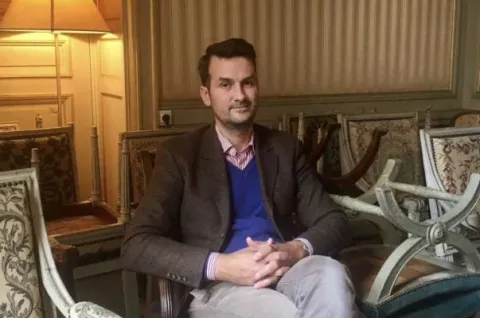
On the occasion of the exhibition “Dans le cabinet d’un amateur d’art” organized by second-year Old Master Art Market students, among the works presented, we can admire “a chair for the Marquis de Talaru,” part of the collection of Charles Hooreman, a former IESA arts&culture student in art market.
On this occasion, we met him.
Which program did you follow at IESA arts&culture?
I attended IESA around the year 2000, for a 3-year program in Art Market specializing in furniture.
- What did IESA bring you?
IESA truly sparked my passion for antique furniture, thanks to our various professors, but also thanks to the first internship I obtained through IESA’s address book. This internship, which lasted at least a year, at a very good antiques dealer, was a revelation. IESA completely gave me a foot in the door.
- What is your job now?
I am now an antiques dealer, specializing in 18th-century French seating furniture.
- Can you introduce the chair that you lent for the exhibition “In an Art Lover’s Cabinet”?
The chair in the exhibition is the work of the seat joiner Jean-Baptiste BOULARD, who held the title of Joiner to the King under Louis XVI. It was delivered around 1785 for the bedchamber of the Marquis de TALARU’s apartment at the Château de Fontainebleau. It was then recorded under number 831 in the 1787 inventory at Fontainebleau. Today’s art lover is very sensitive to the elegance and line of a piece of art furniture, to the name of the craftsman who made it, but above all to its provenance. And the provenance of this chair is royal. The most exciting thing about this chair is therefore… its mark! It is a stenciled mark, with the crowned “F” for Fontainebleau.
- How does it fit within the exhibition?
I noticed that the exhibition was oriented toward “old” art. This chair therefore belongs to this French artistic period: the Ancien Régime. Louis XVI and Marie-Antoinette knew similar chairs, sat on similar chairs, made by the same Boulard, and they may even have seen this one during their stays at Fontainebleau.
