

Meeting Axelle Perona, an IESA graduate, now logistics coordinator at ZED, a documentary production company
Hired following her work-study placement, she looks back on her path and her daily life at the heart of international documentary distribution, and shares her advice for getting started in the sector.
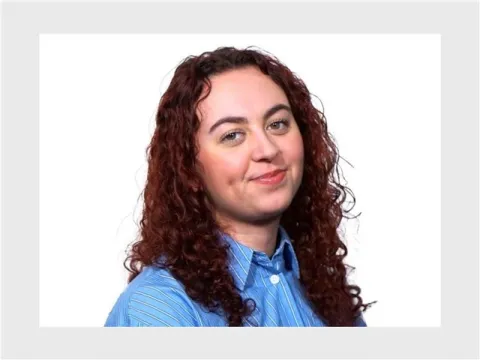
Hello Axelle, to begin, can you introduce yourself?
After an undergraduate degree, then a first year of a master’s in film and audiovisual studies at a university in the south of France, I wanted to move to Paris to multiply my opportunities for internships and work-study placements and to build real professional experience. I therefore joined the IESA Master 2 in Audiovisual and Film Production and Distribution, in a work-study placement at ZED, a company specializing in documentary production and distribution. At the end of this work-study placement, I was hired as a logistics assistant, a position I still hold today and which allows me to keep progressing in the audiovisual sector.
What does your daily life look like?
My daily life is quite varied and fast-paced. As a logistics assistant attached to the distribution department, I handle the tracking of program deliveries, the management of technical elements (masters, press materials, etc.), the channels, and the internal teams. I also work on making the English versions of programs, together with the various service providers, coordinating with the labs in order to meet the requirements of international broadcasters. I work closely with the production and distribution teams and with outside partners, which requires good organization and a lot of communication. No two days are alike, and you often have to know how to adapt to scheduling constraints and to the specific demands of broadcasters.
Are you fulfilled? What makes you happy in your job?
Yes, I feel fulfilled and lucky in my job. What makes me especially happy is taking a concrete part in the distribution of documentaries, seeing projects come to fruition and be broadcast internationally. Working on programs that have meaning, while being at the heart of the production and delivery process, is very stimulating. I also enjoy the variety of tasks, the teamwork, and the feeling of being useful at every stage. Every project is different, which makes daily life dynamic and rewarding.
What have you discovered in your daily work about your aspirations, about yourself?
My day-to-day work has helped me better understand my aspirations and how I work. I discovered that I like roles that are both operational and cross-functional, which require rigor, organization, and a good ability to adapt. I also became aware of the importance of communication and teamwork, especially in an environment where deadlines and technical requirements are demanding. On a personal level, this position taught me to become more autonomous and to manage priorities more calmly.
Which aspects of your IESA training help you carry out your duties? What do you put into practice, for example?
The IESA program gave me a solid foundation in production and project management, which I put into practice every day. The theoretical courses helped me better understand the challenges of the audiovisual sector, while project-based teaching and group work taught me to work in a team, meet deadlines, and organize myself efficiently. The work-study format was also a major asset: it let me draw a direct link between what I learned and the reality of the field, especially in very concrete areas such as project follow-up or managing production and distribution constraints.
What did you particularly enjoy about your studies at IESA?
What I particularly appreciated at IESA is the very career-oriented approach of the program. The instructors are professionals from the sector, which makes for concrete teaching rooted in the reality of the job. I also really liked the emphasis on projects, group work, and work-study, which encourage a quick immersion in the professional world.
Can you tell us about your end-of-studies PGR?
My end-of-studies PGR was an event project called RENCONTRES ÉMERGENTES. It was a multidisciplinary event combining a live concert, a DJ set, a screening of short films, and a photography exhibition. I wanted to create this event to give emerging artists a space for expression, since they do not always have venues to present their work. The goal was both to showcase artistic creation and to encourage encounters between different worlds. Even though the organization was complex, notably because of the limited time, I loved the experience. It allowed me to draw on many skills acquired throughout the year and also made me realize that events is a field that could interest me professionally.
A standout moment during your studies?
A particularly memorable moment of my studies at IESA was the masterclass we had the chance to attend with Karim Leklou. The exchange was very inspiring, both for his career, his vision of the profession, and the sincerity of his words. Being able to talk with such a committed and passionate artist was very motivating and gave even more meaning to our commitment to careers in culture and audiovisual.
In your view, what qualities or skills are needed to succeed in the audiovisual sector?
In my view, several qualities are essential to succeed in this sector and in a role like mine. Organization and rigor are indispensable, especially to manage several projects at once and meet sometimes tight deadlines. Adaptability is also very important, because requests can change quickly and each broadcaster has its own requirements. Finally, communication skills and teamwork are key, because this job involves many exchanges with a variety of contacts, both internal and external.
What advice would you give to a student who wants to get into film and audiovisual but is still hesitating?
I would tell them not to hesitate to go for it and to take advantage of every opportunity to build experience, whether through internships, work-study placements, or student projects. This sector demands a lot of commitment, but it is incredibly rewarding. It is important to stay curious, develop your skills and your network, and not be afraid to step out of your comfort zone. Every experience, even a small one, is formative and can open doors to new opportunities. Finally, you have to show that you are passionate and persevering: that energy can make all the difference!