

Meet Auréline Faci, an IESA graduate who is now a freelancer in performing arts
A graduate of IESA’s Master in Performing Arts Production and Distribution, Auréline Faci now works as a freelancer at the crossroads of production, directing, and artistic coordination. She tells us about her day-to-day work, her aspirations, and what her training brings her in the field.
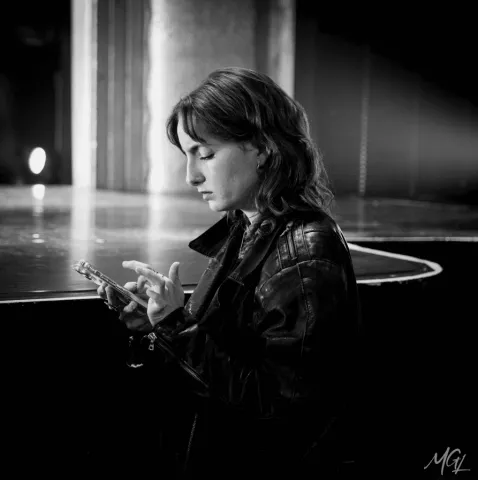
Hello Auréline, to begin with, can you introduce yourself?
I am Auréline Faci, I am 25 years old, and I completed the Master in Performing Arts Production and Distribution at IESA last June. I currently work as a freelancer, as a production manager, assistant director, and artistic coordinator for various organizations, including La Neuvième Production, Drag Race France, and Vers Paris Sans Sida.
What is your day-to-day like?
Freelance status is quite particular: there isn’t really a typical day. There are very intense weeks and calmer ones. Some assignments take a few hours, others can last several weeks, such as organizing the show Battant·es for Vers Paris Sans Sida, which took me a month. I try to always be ready to respond to a last-minute request and, whatever the assignment, to work as much as possible outside my home and with other people.
What makes you happy in your work?
This way of working suits me well; I like the freedom that freelancing offers and the fact that my schedule changes from one day to the next. Being able to work on varied assignments is very positive: it allows me to meet new people, develop new skills, and constantly discover new shows.
What have you discovered in your day-to-day work, about your aspirations, about yourself?
I discovered that I particularly like working in a team, building connections, and working alongside people who inspire me. Surrounding yourself well is, in my view, essential. I also learned that you have to trust yourself, step out of your comfort zone, and that you are capable of much more than you think. Being in the field stimulates me a lot, and I like to work on several aspects of a show: my experience in stage management taught me as much as production, notably on the show Fantasma.
Which aspects of your IESA training help you carry out your duties? What do you put into practice, for example?
During my studies at IESA, the PGRs (real-scale projects) were particularly formative, especially the classes that helped us design them. Carrying out a project from A to Z, including setting up an association, builds confidence in your ability to propose, organize, and defend a project. The theoretical foundations, particularly in administration, payroll, intermittent status, and law, were also very useful to me.
What did you particularly like about your studies at IESA?
I particularly enjoyed the general-culture classes such as contemporary music and performing arts, as well as the show outings that let you discover works you might not necessarily have gone to see. Meeting people who are passionate about the same things to undertake projects together is also one of the most rewarding aspects of the program.
Can you tell us about your end-of-studies PGR?
For our end-of-studies PGR, we created Chrysalis, a charity evening at Point Éphémère combining a concert, a cabaret, and a DJ set. It was a project we had started in our first year and chose to develop in M2 with the same team. We had imagined a retro-futuristic universe and donated the proceeds to the association TIMMY – Team mineur·es exilé·es. The evening opened with the psychedelic rock band Half Pipe, followed by a cabaret with Mimi, PowerBeautom, Michelle Tshibola, and Ruby On the Nail, and closed with DJ sets by Azak and Rozitaa.
A standout moment during your studies?
Attending the FTA festival in Montreal was a valuable opportunity! Being able to travel, meet professionals, discover international shows…
In your view, what qualities or skills are needed to succeed in the performing arts sector?
To advance in this sector, I think you above all have to be curious and open-minded. Enjoy stand-up but go try out a cabaret, be a production manager but take an interest in the work of a lighting designer: understanding the creative process as a whole is essential. You also need to be organized: not be afraid to take the initiative, anticipate as much as possible, while knowing there will always be unforeseen events, and of course not forgetting to stay cool-headed and solve last-minute problems calmly.
What advice would you give to a student who wants to get started in the performing arts?
I would recommend that they talk with anyone working in this field (production, administration, lighting, sound, stage, wardrobe, directing, choreography…) and listen to the anecdotes they may share. I would also advise them to go see as many shows as possible (circus, dance, concerts, cabaret, comedy, opera…) and to keep a record of them somewhere. Finally, if they have a passion for any area of the performing arts, I would encourage them to dare to jump in: the encounters and experiences will only be more stimulating.