Zakiya Tamaghlift
AKAL ⴰⴽⴰⵍ: Contemporary Amazigh Art
Which program are you following at IESA? Is this your first year at the school?
I am in the 3rd year of the Bachelor in Cultural Productions Film and Audiovisual; it is my 3rd year at IESA.
You are preparing an ambitious study project; can you introduce this project and the part of your program it fits into?
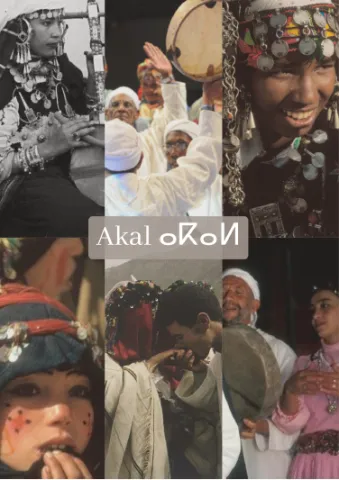
In the 3rd and final year of the Bachelor, each student must carry out a cultural project of their choice (exhibition, concert, charity event, documentary, etc.) in order to earn their degree. It is in this context that I am embarking on making my first documentary, called Akal ⴰⴽⴰⵍ. This documentary will paint portraits of visual artists, musicians, photographers, painters and dancers of Amazigh origin. I want to go and meet them, in order to understand and highlight how they express their Amazighness through their artistic specialties. I want to shed light on what drives them, their commitment, and the obstacles and opportunities they encounter.
Akal (which means "earth" in Berber) is the name I chose for this documentary. I am French-Moroccan and Berber; it was necessary for me to link my roots to this project. Indeed, having been steeped in multiculturalism all my life, I want to make my culture of origin and the players of its influence better known. Using art as a common thread is obvious to me, because I was raised, from my earliest childhood, on verbal jousting and Berber poetry. It is these oratory arts that allowed my family to keep a link with their roots and, at the same time, this art awakened in me the desire to learn more about my origins and its history. Making this documentary drives me, because for me it is an initiatory journey to rediscover my roots. I have always dreamed of being a historian or an anthropologist; this project makes it possible to fulfill my childhood dream through images.
This documentary is an initiatory journey set to Amazigh music, punctuated by landscape shots of the different regions of Morocco that we will discover as we go to meet the artists. I will pass through Tamdakht and the Ksar Ait Ben Haddou, head back up toward Agadir and Azilal and end this journey in Paris, the starting point that saw this project born.
For newcomers, can you explain who the Amazigh are? Where do they come from? Why do they call themselves that?
The Amazigh are also known as Berbers. The Berbers, whose presence predates Arabization and Islamization, call themselves "Imazighen," the plural of "Amazigh," which means "free man" in their language, Tamazight. They are located mainly in the Maghreb: Morocco, Algeria, Tunisia, and Libya, where these populations demand broader identity and cultural recognition. After the Arab conquests that began in the 7th century, North Africa slowly became Arabized, but the Amazigh population, present long before, remained in areas such as the countryside, mountains, and oases. About forty dialects derive from ancient Berber: Shilha and Riffian in Morocco, Kabyle and Chaoui in Algeria. Only Morocco and Algeria have recognized Berber as an official language on equal footing with Arabic. Amazigh culture is rich, and it seems to me completely unknown here in France.
For many people, it is difficult to see the singularity of each culture when it comes to the Maghreb and Africa in general. I have often been categorized as Arab, yet I am not. I deconstruct this conflation around me, because this lack of information and knowledge categorizes individuals and locks them into molds with which they do not identify. I sense a surge of assertion regarding the cultural belonging of young people of my generation through art. It is a positive assertion, not a rejection of the values of our country of birth or of our host country; it is a desire, and sometimes a need for some, to bring out this other facet of what builds us culturally, intellectually, and in terms of identity. In France, the debates on the integration of minorities, said to be "necessary for living together," impose a certain homogeneity on the population, yet I think our differences are a source of richness. They allow us to debate, to educate ourselves, to learn, and to be tolerant of the differences of others. In my view, the audiovisual medium has a universal value that brings us together for the length of a screening and around a subject. That is why I want to link my origins to my audiovisual studies in order to introduce Berber culture through my documentary.
Can you walk us through how you go about the shoot, all the way to post-production?
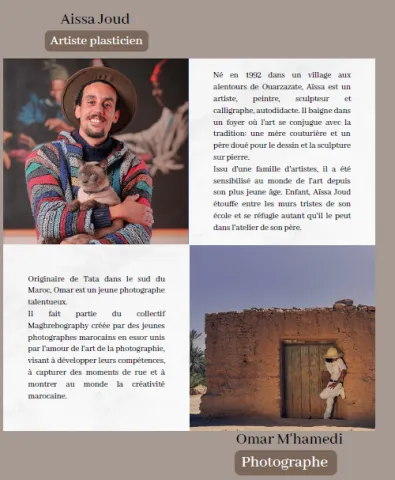
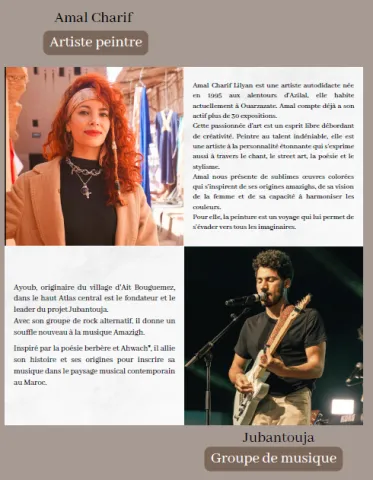
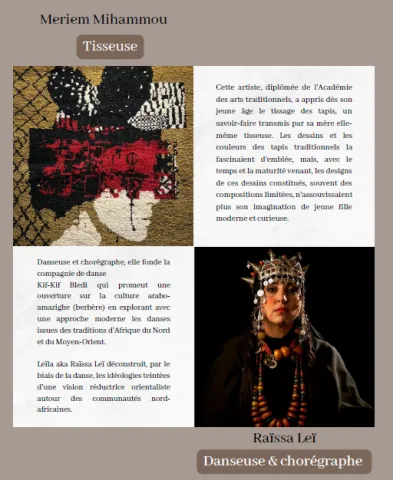
First, I had to think through the project and the concept, find what I wanted to talk about, and then accept taking on this challenge. I have never directed anything, and I’m launching into a documentary in Morocco, it’s a real adventure! I quickly found my subject and the Berber artists I want to feature: Aissa Joud, Omar M’Hamedi, Jubantouja, Raïssa Leï etc. I proposed my project to them and they accepted the invitation. I then managed to surround myself with a small team: a production coordinator, a legal structure, a local production company, and a director of photography. It is important to me to combine France and Morocco in this project, and all the members of my team have ties to both of my countries.
It is also a family adventure: my cousin is the founder of a small production company based in Agadir, Morocco, and he will accompany me at every stage of the documentary: scouting locations, the two weeks of shooting in southern Morocco, and post-production. We are both passionate about audiovisual media and each of us works in this professional field. For my part, I am in a work-study program at a Paris production company. It is a real plus to have someone I trust right there. I already know my way around Morocco, I speak the language, I know the philosophy of life, etc. It immediately makes the idea of shooting abroad much less daunting.
On top of all this, I had to think concretely about the documentary as a director: the synopsis, the pitch, the shots I have in mind, the camera movements, the emotions I want to convey, the interviews with the artists. It is a new exercise for me that I enjoy a lot. There is also the whole production side, where I am supported by a former IESA student: drawing up a provisional budget, defining our technical needs, the two-week shooting itinerary given that we have several cities in Morocco to shoot in, and finding funding. On this last point, we decided to open a crowdfunding campaign to fund the main parts of the project (transport, equipment rental, post-production). It is a stance, because we believe this documentary is necessary to showcase a little-known culture. There is a sense of pride within the Maghrebi/Moroccan/Amazigh community, and we also have the support of an audience that perhaps knows less, or nothing at all, about this culture and is curious to discover it.
It is interesting to be able to bring two audiences together around this subject that is so dear to me. If you wish to take part in funding the project, here is the link to the fundraiser:
https://www.okpal.com/aide-financement-documentaire-akal-l-art-berbere/…
What did IESA bring you in carrying out the project?
We have regular follow-up with a supervising professor who is our "coach" and guides us through every stage of the project; we can ask them any question and they advise us on our path. I am also in touch with a former student who herself carried out a project related to Morocco last year and whom I met at her event. Having (former) classmates who all work in this field is beneficial, because there is always someone who knows and who can help us.
What are the school’s strengths?
Having the opportunity to carry out your own project is a plus, even if it scares all the students, myself included. It is something very important, because it is the culmination of three years of study but also the first big professional project I am undertaking and with which I may start a career! Being surrounded by professors who are professionals in the cultural fields is also a plus. They know what they are talking about and have contacts and resources to help us.