

Work-Study at the Paris National Opera Academy: The Journey of Tony, IESA Student
An actor, stage director, and opera singer, Tony is passionate. A student in the Master 2 in Performing Arts Production and Distribution at IESA and a work-study student at the Académie de l’Opéra national de Paris, he looks back on his day-to-day work, the projects that have marked him, and his ambition to bring more inclusivity and accessibility to the performing arts.
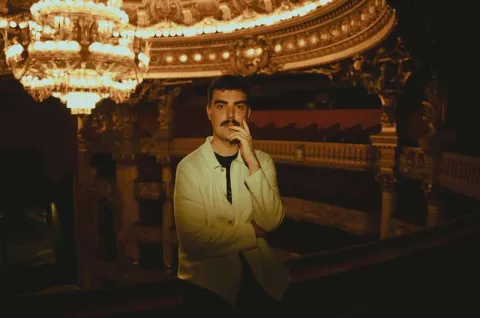
Hello Tony, to begin with, can you introduce yourself?
I am a 24-year-old who has been involved in the performing arts for six years now, with a hybrid background combining artistic practice, cultural mediation, and project management. I am an actor, stage director, and opera singer, trained in the stage arts from childhood at Opéra Junior, under the artistic direction of Jérôme Pillement. This early training allowed me to develop a concrete understanding of artistic work, collective discipline, and the demands of the stage.
I am currently pursuing a Master 2 in Performing Arts Production and Distribution at IESA, as part of a work-study program leading to the Cultural Project Administrator certificate. My work-study placement takes place at the Académie de l’Opéra national de Paris, in the department led by Myriam Mazouzi, where I take part in designing and implementing arts and cultural education projects.
In addition, I am also a national handball referee, player, coach, and trainer of young referees, an activity that complements my background and strengthens my skills in group management, teaching, and decision-making.
What motivated you to join the Académie de l’Opéra national de Paris?
Joining the Académie de l’Opéra national de Paris was a logical continuation of my path. Having been trained very early in the opera sector as an artist, once my artistic training was over I wanted to understand its overall workings, particularly from the administration and mediation perspective. So I applied for a Civic Service volunteer position at the Académie de l’Opéra national de Paris. This assignment lasted eight months and led to a new work-study contract.
The Académie stands out for its commitment to arts and cultural education, audience diversity, openness of practices, and inclusivity. This approach fully matches my desire to contribute to artistic projects that are both demanding and socially engaged. All within an organization that has significant resources.
What is your day-to-day like?
My day-to-day at the Académie includes varied assignments, carried out within a multidisciplinary team of 20 people, divided into two units: a unit for managing and supporting artists and craftspeople in residence, and an arts and cultural education (EAC) unit. I therefore take part in coordinating EAC projects, in the administrative and organizational follow-up of activities, in relations with artists and educational and institutional partners, in logistical preparation, and in project evaluation. I also help design educational publications (teaching kits, audience booklets, show programs, etc.). This diversity allows me to understand the entire production chain, from design through to project delivery. There is no real typical day.
Which projects have marked you the most so far? What role did you play?
Several projects carried out at the Académie de l’Opéra national de Paris particularly marked me, notably those that place encounters between so-called "distant" audiences at the heart of their approach. These experiences allowed me to measure very concretely the impact of cultural action, but also the essential role of mediation in the success of these projects.
One of the most memorable projects was an encounter between young athletes from the Paris Saint-Germain training center and students from the Opéra national de Paris’s Dance School. The aim of this encounter was to bring two seemingly distant worlds, elite sport and classical dance, into dialogue around shared values such as discipline, rigor, physical commitment, teamwork, and the very similar daily lives of the young people. The PSG youngsters were able to discover the Dance School, visit the work spaces, and talk with the student dancers about their respective paths. In this context, I acted as a mediator and organizer, helping prepare the encounter, welcome the groups, and facilitate the discussions.
Another formative project was my participation in the show Échos, produced as part of the Ten Months of School and Opera (Dix Mois d’École et d’Opéra) program. This project, choreographed by Delphine Jungmann, offered students a full immersion in a professional artistic process. My role was to handle the show’s general stage management, to act as a link between the educational teams, the artists, and the institution, and to support students in understanding the artistic and staging issues. This project particularly struck me through the gradual transformation of the students: growing confidence, ownership of artistic language, and the ability to express themselves through body and stage. It perfectly illustrates how lyric and choreographic art can become a tool for emancipation and personal development.
Finally, I am producing the show program My First Time at the Opera (Ma première fois à l’Opéra), an educational tool designed to guide audience members discovering the Opera and the performing arts for the first time. This program aims to remove the symbolic and cultural barriers to attending the institution by offering clear, accessible, and contextualized content: discovering the venue, the codes of the auditorium, the professions, and the works. This assignment allowed me to work on written mediation and to understand the importance of editorial tools in broadening audiences.
What have you discovered in your day-to-day work, about your aspirations, about yourself?
This experience confirmed my interest in positions of responsibility at the intersection of the artistic and the administrative. I also became aware of the importance of rigor, anticipation, and teamwork in the success of cultural projects. My parallel sports background also helped me a great deal in developing transferable skills such as conflict management, teaching, and decision-making.
Do you want to continue down this path? What are you aiming for at the end of your studies?
Yes, I want to continue down this path after my studies.
My goal is to create, in the medium term, a production company specializing in the performing arts, with a particular focus on opera. I want to develop projects that question issues of equality and inclusion, notably in terms of gender, body representation, and artistic discourse, while remaining within a professional and viable production framework.
Which aspects of your training at IESA helped you carry out your assignments? What do you put into practice, for example?
The training at IESA gave me skills that I can directly use in my work-study placement, notably budget and financial management, performing arts law, and project methodology.
Can you tell us about your PGR (real-scale project)?
Opera is still marked today by aesthetic and narrative norms that are sometimes not very representative of contemporary diversity. My PGR is a direct continuation of my artistic background, my experience in mediation, and my administrative training. It aims at creating, in the medium term, a production company dedicated to the performing arts, with a strong foothold in the field of opera.
The starting point of this project is an observation shared by many players in the sector: despite a growing willingness to open up, opera is still largely shaped by aesthetic, physical, and narrative norms that can hinder access for certain artists and certain audiences. These norms influence both stage representations and the conditions of production and distribution of works.
The central question of my PGR is therefore the following: how can one design an opera production company capable of reconciling artistic rigor, economic viability, and a commitment to equality and inclusion?
The project aims to address this issue by developing:
- opera and multidisciplinary productions that question traditional representations of gender, body, and discourse;
- adaptable distribution formats, promoting access for diverse audiences, notably outside the usual venues;
- mediation and arts and cultural education activities built into the design of projects from the outset.
This PGR is thus a structuring step in my career: it formalizes a coherent professional vision and lays the concrete foundations of an entrepreneurial project grounded in the contemporary issues of the performing arts.
In your view, what qualities or skills are needed to succeed in a cultural venue like the Académie de l’Opéra national de Paris?
Succeeding in a cultural venue like the Académie de l’Opéra national de Paris requires above all adaptability and great professional rigor. Projects and teams there are complex, involve many stakeholders, and operate within a demanding institutional framework.
It is essential to show a keen sense of organization, in order to manage projects with long timelines and multiple constraints; interpersonal skills, in order to work effectively with very diverse artists, educational teams, partners, and audiences; a fine understanding of artistic and cultural issues, indispensable for supporting projects without distorting them; and an ability to listen and mediate.
Finally, genuine curiosity and a sincere commitment to the public-service missions of culture are, in my view, decisive for building a lasting place in this kind of organization.
What advice would you give to a student who wants to get involved in the performing arts or in a cultural organization like the Académie de l’Opéra national de Paris?
I would first advise them to gain as much field experience as possible, in order to concretely understand the reality of the performing arts professions. Nothing replaces hands-on experience for grasping the constraints, rhythms, and responsibilities specific to the sector.
I would also recommend developing a solid artistic culture, while taking an interest in the economic, legal, and political issues of the sector; adopting an open and proactive attitude, not hesitating to offer help, ask questions, and get involved in projects; and cultivating versatility, which is particularly valuable in cultural organizations where assignments are often cross-functional.
Finally, I would tell them that commitment to the performing arts requires perseverance and a real ability to work collectively, but that it offers in return the chance to contribute to projects that are meaningful and have an impact on society.