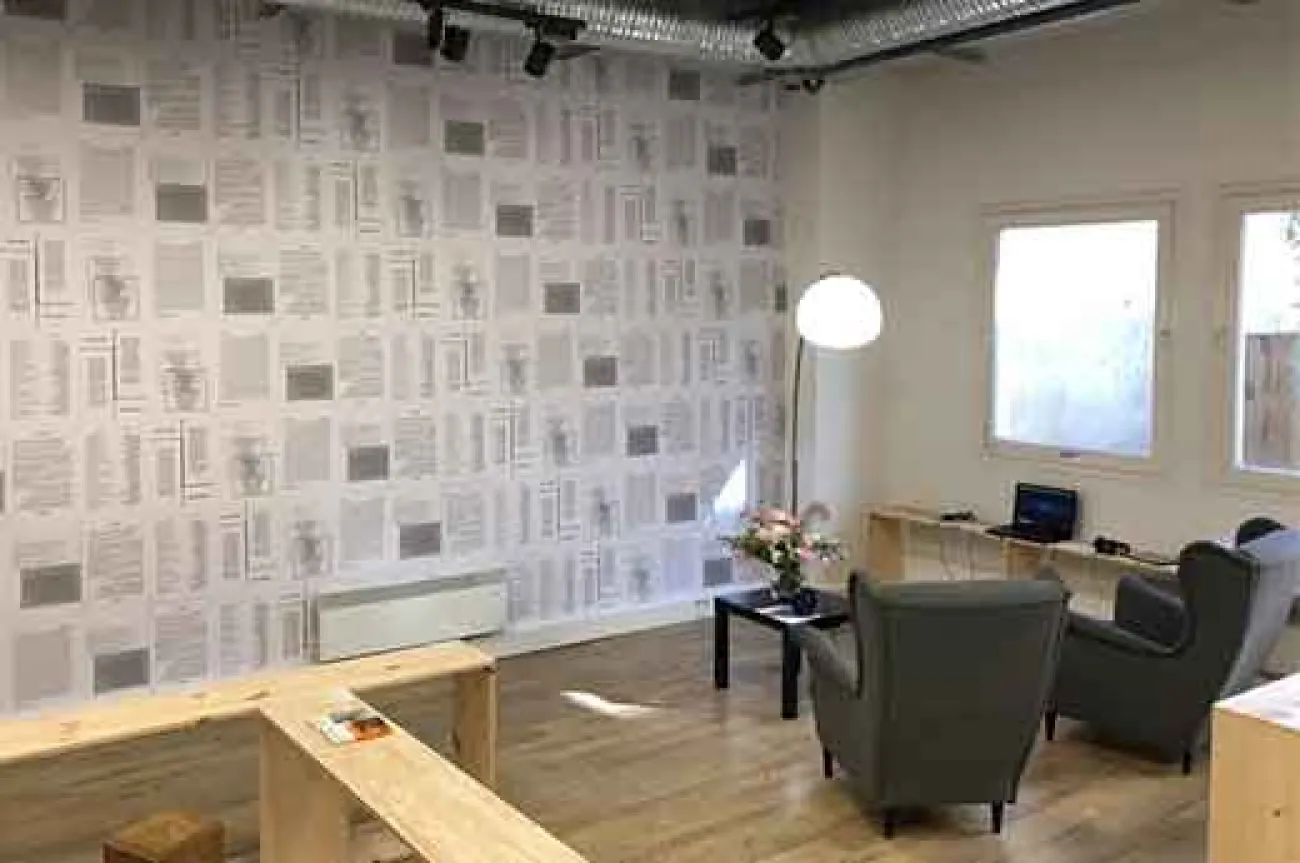
The exhibition “Borges y yo” was held at the IESA arts&culture gallery at the end of April. It was organized by Grecia Caceres as part of her “Read and Create” module, with students in the Master 1 in Culture Careers and Carolina Ariza, exhibition curator and lecturer at IESA arts&culture.
We interviewed Grecia Caceres and Johane Genovès, students in the Master 1 in Exhibition Curating, about this very successful event.
Grecia, can you tell us about your role at IESA arts&culture?
I head IESA’s Latin America department, whose aim is to make Latin American art and culture known as accurately as possible in France and also to support the promotion of Latin American artists in Paris and in France. To that end, my department offers courses, seminars, workshops, exhibitions, and monthly lectures such as L’œil pense in partnership with the Maison de l’Amérique latine. This year, for the first time, I led a module called Read and Create on the work of Jorge Luis Borges. This coaching culminated in the exhibition Borges and Me.
Johane, what is your program at IESA?
After a bachelor’s degree in cultural project production, with a specialization in exhibition installation, this year I am following a Master 1 in art market - exhibition curating specialization at IESA, in a work-study arrangement alongside my job as an assistant for the gallery 127.
Can you briefly present this project to us?
Grecia: It is a very singular exhibition because its guiding thread is the voice, listening, and the reading of Borges’s texts. With Carolina Ariza and the students, we proposed a sound walk with recordings made in the street and in the studio. We also have a fine sound and visual creation, the video L’Aleph 2021 by Stéphane Génovès, produced by our student Johane Génovès!
Grecia, how did the project come about?
The project came from my literary background; I am a poet and novelist myself. I wanted literature and art to be brought together in the gallery space for the length of an exhibition. I took charge of the literary part and Carolina Ariza, exhibition curator, of the artistic part. Borges was an obvious choice, his work being universal: short stories and poems, in short form, which let us read several texts during the coaching.
Johane, what was your role in the project?
The voice and the appropriation of Borges’s world through reading is the common thread of our sound walk. I was in charge of recording nine readings in French, Spanish, English, and Chinese under the direction of the actress Patricia Franchino, who lent us professional equipment and her advice on interpreting the texts. We were thus able to offer the public a sound walk in which they could discover and enjoy nine texts by Jorge Luis Borges read by ourselves, students and professors, but also by a professional actress.
I was also in charge of a contemporary creation around an excerpt from L’Aleph written by Jorge Luis Borges and published in 1949. I chose the actors Eddie Chignara and Patricia Franchino, who lent us their voices. Then I invited the artist Stéphane Génovès to produce images from the recorded voices that convey the world of the Aleph. We thus created a very beautiful video that we screened during the exhibition.
Finally, I took part in installing the exhibition, writing the wall labels, and mediation around the exhibition.
What is your assessment? What did this exhibition bring you?
Grecia: An extremely positive outcome. All the students, 24 of them, got fully involved despite busy schedules: they are all in internships, and the exhibition was truly the result of very rich shared reflection and collective action. A wonderful experience for an exhibition of very high quality. The only downside was the short duration, two days open after three days of installation! I would like to repeat the sound walk experience with another Latin American writer next year…
Johane: Borges and Me was the first exhibition I got to help create. I really enjoyed designing this project with others; sharing a collective project at a time when we are isolated from one another was a driving force for me.
Translating Jorge Luis Borges’s literature into an exhibition made me realize how rich literature is and how it can communicate with other fields of creation and be the central subject of an exhibition just like visual works. Grecia Caceres and Carolina Ariza managed to share with us their interest in Borges’s world, which I liked and found inspiring.
Sharing with the artists and students while making the video and the recordings made for some very beautiful moments of exchange. This project also inspired me for my own future projects. I would like us to be able to keep this sound walk concept alive and extend it to other authors and other ways of displaying texts.