

Producing a film means first managing to raise the money before shouting "action."
In 15 seconds, understand how to finance your film.
This guide details five essential levers: public funding (CNC, regions), private investors, crowdfunding, international co-productions, and building a solid financing plan. Designed for emerging producers and established teams alike, it offers a clear path for turning an idea into a funded project.
French film financing: who pays for what?
Who Finances a Film?
The producer oversees the entire financial package. Television networks (Canal+, France Télévisions, Arte) pre-purchase broadcast rights. Distributors advance sums against theatrical exploitation. Private investors (SOFICA, business angels, crowdfunding) complete the financing plan.

Roles of the producer and public institutions
The producer assumes legal and financial responsibility for the project. They transform the creative idea into a viable file and coordinate all the stages.
Public institutions play a decisive role. The Centre national du cinéma (CNC) distributes automatic and selective aid. Regions offer subsidies tied to local economic benefits.
In 2023, nearly €1.2 billion of public support was mobilized for the French film industry.
What is the average budget for a feature film?
The average budget of a French-initiated film stood at €5.09 million in 2024, steadily rising for four years.
This average hides great diversity:
- 24% of films have less than 1 million euros
- 37% fall between 1 and 4 million
- 22% exceed 7 million
Salaries generally represent 30 to 40% of the total budget.
| Type of funder | Average contribution |
|---|---|
| Public aid (CNC, regions) | 25-30 % |
| TV channels | 20-35 % |
| Distributor | 10-20 % |
| Private investors | 15-25 % |
| Producer contribution | 5-15 % |
Train in Audiovisual Financing
To concretely master the mechanisms of film financing, IESA’s Master Audiovisual Production and Distribution trains students in the realities of the sector: seeking funding (grants, co-productions, pre-sales), putting together files and distribution strategy. A career-oriented approach that helps you understand and manage the financing of a project from A to Z.
Film financing plan: an essential first step
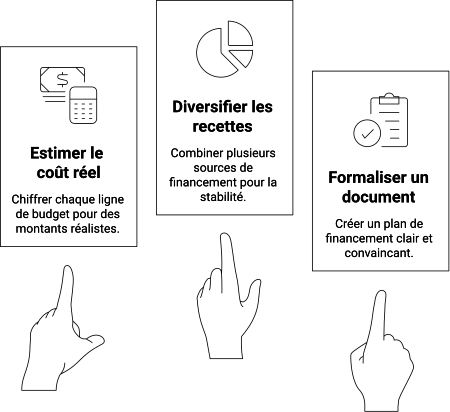
1. Estimate the real cost of the project
Put a figure on every line of your budget. For a contemporary film, expect about 10% of the total budget for sets. If your project is historical or futuristic, double this share (20%).
Detail precisely:
- Sets and costumes
- Digital visual effects
- Moving image
- Technical crew salaries
Do not forget post-production expenses (15 to 20% of the total cost).
3. Put together a convincing document
Your financing plan should fit on one clear A4 page: expenses (quotes) on one side, revenue (confirmed and pending contributions) on the other.
Attach these essential documents:
- Detailed quote by expense item
- Synopsis and statement of intent
- Realistic production schedule
- List of confirmed partners
- Forecast of local economic impact
A well-structured document reassures funders and proves your professionalism. It becomes your best negotiating tool.
2. Diversify your revenue from the start
A solid financing plan combines several sources. Never rely on a single funder.
Identify your potential revenue: public aid (CNC, regions), co-producer contributions, broadcaster pre-sales, private investors, tax credits.
Every euro invested generates on average €6.60 in direct economic benefits for the territory (pay, technical spending) and €1 in tourism benefits. This figure is of particular interest to local authorities. Highlight it to win over regional committees.
CNC and regional aid: lever no. 1
Funding from the Centre national du cinéma (CNC)
The CNC offers three major mechanisms:
- The advance on receipts remains the flagship scheme for independent creators. In 2025, 76 projects were supported, including 52 advances before production.
- The automatic account: companies that have already produced supported works automatically generate a reinvestable credit.
- Selective grants complete the scheme for writing, rewriting, or producing feature films.
Focus on Île-de-France and Other Attractive Regions
Île-de-France concentrates 75% of the sector’s opportunities. The Region awards grants calculated as a percentage of the budget and local expenditure.
Other regions are developing their own funds. The audiovisual hubs of Lyon, Lille, and Marseille offer competitive schemes.
Advance on Receipts and Automatic Account: How to Activate Them?
For the advance on receipts before production, submit your file as an author, director, or through your production company.
To activate an automatic account, your company must reach a minimum threshold: €80,000 for documentaries. This account lets you request up to 40% of the available sums.
Crowdfunding: attracting the public and private investors
Choosing the Right Platform
Touscoprod by Proarti remains the historic benchmark for French cinema, with more than 800 films financed. Ulule and KissKissBankBank reach a broad audience. Kickstarter suits international projects.
Winning Over Private Investors and Patrons
Private investors complement public grants. Initiatives such as the Cannes Film Festival’s Investors Circle build bridges between creators and funders.
To convince, bet on a professional teaser that captures the film’s world in 90 seconds maximum.
Rewards and Communications
The €50 and €100 tiers generate most of the funds raised.
Vital elements of a successful campaign:
- Punchy teaser video (2 minutes max)
- Clear and catchy synopsis
- Detailed and transparent budget
- Rewards at every level (€10 to €500)
- Regular updates during the campaign
The first 48 hours and the last 48 are decisive.
Short film, documentary, European co-productions
Financing a Short Film through the CNC
The CNC supports short films in all their forms at every stage of the project.
Three main levers:
- Business program assistance
- Post-completion assistance
- The automatic account that can be used
The writing residencies offer personalized support.
Documentary: Key Funding and Broadcasters
To fund a documentary, turn to the CNC’s Fonds d’aide à l’innovation documentaire (FAI DOC). Consider key broadcasters such as France Télévisions or Arte, which regularly co-produce documentaries.
European Co-productions: Maximizing Your Chances
The MEDIA program of Creative Europe supports co-development between production companies from different countries. Eurimages specifically funds the co-production of feature films and documentaries.
| Format | Average budget | Key schemes |
|---|---|---|
| Short film | 15 000–80 000 € | CNC, regional funds, residencies |
| Documentary | 100 000–500 000 € | FAI DOC, broadcasters, MEDIA |
| Feature film | €3–8 million | MEDIA, Eurimages, advance on receipts |
Putting Together the Grant Application File
Synopsis, Screenplay, and Production Schedule
Your synopsis must be catchy and concise:
- set the framework
- the main characters
- the dramatic stakes
- the resolution in one to two pages
As for the production schedule, be realistic. Break down each phase with precise dates.
Prove the Local Economic Impact
Every euro invested generates on average €6.60 in direct local returns.
Detail the on-site spending:
- regional technical providers
- local teams
- set rental
3 Common Mistakes to Avoid
- A vague financing plan: unjustified forecasts, uncertain sources, no personal contribution.
- Incomplete documents: file without a broadcaster commitment, missing financing plan.
- No targeting: pitching an intimate documentary to a mainstream commercial channel.
How to Finance Your First Film?
Target schemes dedicated to emerging filmmakers (CNC first film, regional grants), build a convincing file with a synopsis and a realistic budget, then explore crowdfunding to top it up.
The CNC’s advance on receipts before production remains your best ally. In 2025, 20 first films were supported out of 76 funded projects. This scheme requires a finalized screenplay and a solid statement of intent.
Writing residencies offer new talents personalized support to refine your project before major funding.
On the crowdfunding side, Touscoprod by Proarti remains specialized in French cinema. Successful campaigns raise on average €15,000 to €30,000 thanks to attractive rewards.
Regional funds value local economic impact and the employment of regional technical teams.
How to Credit a Film?
The credits must mention the authors of the work, the technical team, the actors, and the financial partners, in accordance with French legal requirements.
The mandatory credits include the National Cinema Center: “with the support of the National Center for Cinema and the Moving Image” in the opening credits.
Each region imposes its own mandatory credits. Partner television channels (Canal+, France Télévisions, Arte) and distributors negotiate their visibility according to their contracts.
European co-productions add their own requirements under international agreements. Crowdfunded films often name their contributors in a dedicated credit.